

We may earn a commission when you buy through links on this page, at no extra cost to you. Learn more.
To answer how much epoxy do I need for a table top, divide the surface area in square feet by the coverage rate, then add a buffer for overflow and porosity. TotalBoat and WiseBond both cite about 12 square feet per gallon at 1/8 inch for a flood coat, while the UltraClear calculator plans with a more conservative 14 square feet. A seal coat is a separate quantity, because one gallon covers either the seal coat or the flood coat, not both.
A table top sounds simple until you start mixing. The amount you need depends on surface area, how thick you pour, how porous the wood is, and how much epoxy runs over the edges. This guide walks through the math, shows worked examples for common table sizes, and explains why pouring too thick in one go causes problems. The figures come from manufacturer calculators and data sheets, so confirm them against the product you actually buy.
How Much Epoxy for a Table Top: The Basic Formula
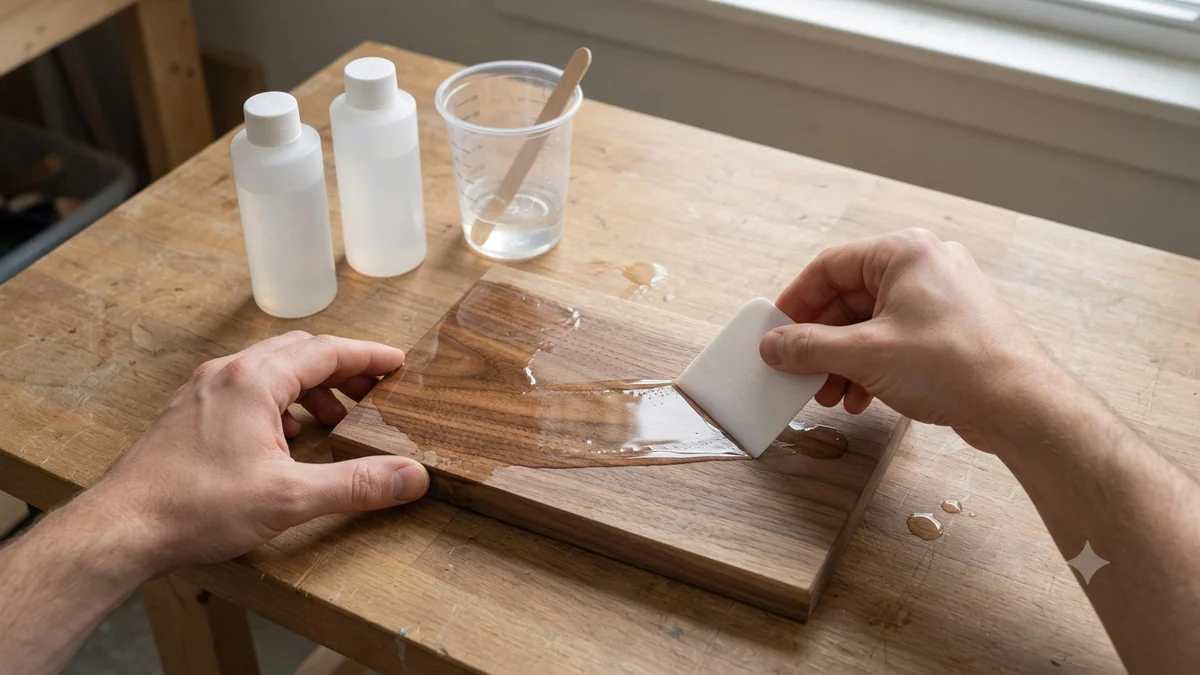
Start by measuring the top in feet, then multiply length by width to get square feet. For a single flood coat, divide that area by the coverage rate per gallon. The result is the mixed gallons you need before any buffer is added.
- Measure length and width in feet. Use a tape measure rather than estimates. Activecalculator warns that rounding a top up from about 7 feet to 8 feet can mean buying a full extra gallon.
- Multiply to get square feet. A top that is 6 feet long and 3 feet wide has 18 square feet of surface.
- Divide by the coverage rate. At 12 square feet per gallon, 18 square feet needs 1.5 gallons for a 1/8 inch flood coat.
- Add the seal coat and buffer. Calculate the seal coat as its own quantity, then add the overflow and porosity allowance covered later in this guide.
Activecalculator also gives a volume formula for pours with depth. Multiply length, width and depth in inches to get cubic inches, then divide by 231, the number of cubic inches in a US gallon. That formula fits a river channel or casting, not a thin coat across the top, so use the area method for a standard table top. For the prep steps that come before any of this math, the TotalBoat table top guide notes that the surface must be level, because self-leveling epoxy follows any tilt.
Coverage Rates for Coating vs Deep Pour Epoxy
Coating epoxy and deep pour epoxy cover very different amounts per gallon, so the product type matters as much as the size of the table. Table top epoxy is made for thin layers that self-level into a glossy surface. Deep pour epoxy is made for thick fills, and it is planned by volume rather than by area.
| Application | Coverage per gallon | Typical thickness |
|---|---|---|
| Table top flood coat, UltraClear planning figure | 14 sq ft | 1/8 inch |
| Table top flood coat, TotalBoat and WiseBond figure | About 12 sq ft | 1/8 inch |
| Table top flood coat, Activecalculator range | 10 to 12 sq ft | 1/8 inch |
| Seal coat, WiseBond figure | 36 sq ft | Thin brushed layer |
| Seal coat on sanded wood, Activecalculator range | 16 to 20 sq ft | 1/16 inch |
| Thinner coat, WiseBond chart | 24 sq ft at 1/16 inch; 48 sq ft at 1/32 inch | 1/16 or 1/32 inch |
| Thick art pour, Activecalculator range | 4 to 6 sq ft | 1/4 inch |
The spread in these numbers is normal. Coverage shifts with the product, the temperature of the room and the surface you pour onto. Activecalculator notes that warmer shops make epoxy thinner and more self-leveling, while cooler conditions below 65°F thicken it and reduce coverage.
For deep fills, the UltraClear calculator says to use a separate deep pour calculator to estimate the fill, then calculate the surface coats on their own. Mixing those two numbers into one total is the most common planning mistake for river tables.
How Much Resin for a Table Top: Worked Examples
Common table sizes show how quickly the math grows. The figures below are simple arithmetic from the 12 and 14 square foot coverage rates, for one 1/8 inch flood coat only. They leave out the seal coat and buffer, which you add afterward.
| Table size | Square feet | Flood coat at 12 sq ft per gallon | Flood coat at 14 sq ft per gallon |
|---|---|---|---|
| 3 ft by 2 ft side table | 6 | About 0.5 gallon | About 0.4 gallon |
| 4 ft by 2 ft coffee table | 8 | About 0.7 gallon | About 0.6 gallon |
| 6 ft by 3 ft dining top | 18 | 1.5 gallons | About 1.3 gallons |
| 4 ft by 8 ft dining table | 32 | About 2.7 gallons | About 2.3 gallons |
For a 6 by 3 foot top, the flood coat alone is 1.5 gallons at 12 square feet per gallon. A 1-gallon kit is half resin and half hardener, so a full project means at least two kits once the buffer is added. Check the kit size on the label, because kit sizes are quoted as combined mixed volume.
A 4 by 8 foot dining table has 32 square feet. The seal coat quantity differs by source, so WiseBond’s 36 square foot seal coat figure gives about 0.9 gallon, while Activecalculator’s 16 to 20 square foot range for a thin seal on sanded wood gives roughly 1.6 to 2 gallons. Plan for the higher number if the wood is raw. Browse more project ideas on the Wood, Tables & Countertops page before you commit to a size.
Adding a Waste and Overflow Buffer
Buffer percentages vary by calculator, so choose the rule that matches your wood and whether the top has a dam or wall around it. Waste from the mixing container is small on a single batch, but edge overflow on an open table can be large. Plan for both before you buy.
| Situation | Buffer or factor from the sources |
|---|---|
| Sealed or non-porous surface | 10% extra (Activecalculator); multiplier 1.0 (ToolCroze) |
| Slightly porous sealed wood | Multiplier 1.1 (ToolCroze) |
| Raw sanded wood | 15% extra (Activecalculator) |
| Rough or porous wood, or raw wood and concrete | 20% extra (Activecalculator); multiplier 1.25 (ToolCroze) |
| Open edges with no dam | 30% allowance on the area (UltraClear); 25 to 30% of product may go to sides and edges (WiseBond) |
The UltraClear epoxy calculator adds a 30% allowance to the calculation area for edge overflow when there is no dam or wall around the top. WiseBond gives a similar warning, saying you could lose 25 to 30% of the epoxy coating the sides and edges. If you want the sides glossy too, plan for that loss from the start rather than running short mid-pour.
ToolCroze’s calculator offers 5%, 10% and 15% waste options, so you can see how each choice changes the total. Activecalculator also notes that you lose a small amount of mixed material to the walls and bottom of the container with each batch. Those losses add up on small pours, so round your final purchase up rather than cutting it close.
Tip: Pick the highest buffer that fits your wood, then round up to the next whole kit. Leftover resin stored in sealed containers can usually be saved for another project. Readers working through this often move on to How Do You Flatten Epoxy Resin with a Router.
Pour Depth Limits and Multiple Coats
Table top epoxy is made for thin layers, so a 1/4 inch finish is built from two passes rather than one heavy pour. Pouring too thick in one go can overheat and distort the finish, so follow the depth limit printed on your product.
UltraClear says its Bar and Table Top Epoxy is limited to 1/8 inch per flood coat, and a 1/4 inch finish is built from two separate 1/8 inch flood coats. TotalBoat says each flood coat should be no thicker than 1/4 inch to prevent overheating or distortion. Because the limits differ, read the technical data sheet for your exact product and use the lower figure when in doubt.
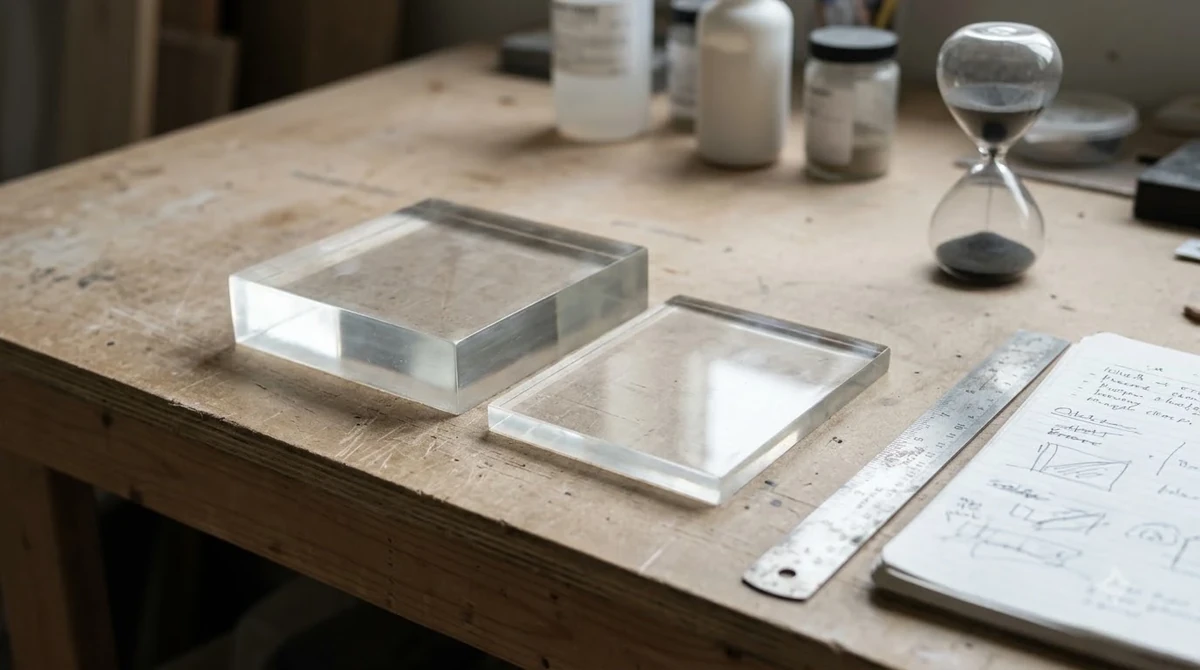
Timing between coats matters too. TotalBoat says to pour additional coats within 3 to 6 hours of the previous layer, and to lightly sand with 120-grit if more than 8 hours pass. WiseBond says additional flood coats can be applied every 24 hours when you need to cover thicker embedded objects. Seal coats on very porous wood, such as barn wood or concrete, may need a second pass about 4 hours after the first, according to UltraClear.
Tip: Set a timer as soon as each coat goes down. Writing the time on the container lid helps you keep track when you are working alone.
Buying Tips, Mixing and Curing Checklist
Buy with the buffer included, mix in batches you can spread within the working window, and allow the full cure before you put anything on the surface. Follow the mixing ratio and temperature on the data sheet, not a general rule.
- Confirm the product type. Table top epoxy is for thin coats. Deep pour epoxy is for fills and has its own calculator.
- Mix by volume. TotalBoat lists a 1:1 ratio by volume, or 1.2A:1B by weight. ToolCroze notes that mixing by weight can throw off the cure if the label does not call for it.
- Work within the pot time. Activecalculator says table top epoxy typically gives 20 to 45 minutes of working time after mixing, so mix smaller batches for large tops.
- Hold the room at 70 to 80°F. TotalBoat says epoxy cures best between 70 and 80°F, with low humidity and minimal dust.
- Expect a slow cure. At 70°F, TotalBoat’s table top epoxy is tack-free in about 6 hours, sandable in about 24 hours, and fully cured in 5 to 7 days. ToolCroze lists a full cure of 7 to 10 days at 60°F.
- Keep objects off the surface. TotalBoat advises avoiding placing objects on the new surface for at least 72 hours.
For the full sequence of prep, pouring and bubble removal, see how to epoxy a table top. That guide covers each step in order, from edge masking to the final sanding.
Safety: Epoxy resin and hardener can irritate skin, and repeated exposure can cause allergic reactions. Wear nitrile gloves and splash-proof glasses, work in a ventilated area, and read the product SDS before you mix.
Frequently Asked Questions
How many gallons of epoxy do I need for a 6 foot table top?
If the top is 6 feet by 3 feet, the area is 18 square feet. At 12 square feet per gallon, a 1/8 inch flood coat needs about 1.5 gallons before buffer. Adding a 10 to 15% buffer brings the total near 1.7 gallons, so plan for two 1-gallon kits and calculate the seal coat separately.
How much epoxy covers 1 square foot at 1/8 inch thickness?
One square foot at 1/8 inch takes about one twelfth of a gallon, based on the 12 square foot coverage figure. Activecalculator states there are 128 fluid ounces in a gallon, which works out to roughly 10.7 fluid ounces per square foot. Your product may cover slightly more or less, so check its data sheet.
Do I need a seal coat before pouring epoxy on a wood table?
Yes, for most wood tops. TotalBoat says a seal coat is poured as a 1/16 inch layer and sanded with 80 to 120 grit after it cures. Very porous materials such as barn wood, cork and concrete may need two seal coats, with the second brushed on about 4 hours after the first.
Can I pour a 1/4 inch epoxy table top in one coat?
Usually not. UltraClear limits its table top product to 1/8 inch per flood coat, so a 1/4 inch finish is built from two separate 1/8 inch pours. TotalBoat advises waiting 3 to 6 hours between layers for a good bond, so follow your product’s timing.
Once your gallons are calculated, you can compare design options on epoxy table top ideas for inspiration on color and finish. Work through the seal coat, the flood coat and the buffer in that order, and buy the total only after you have added all three.
More in Wood, Tables & Countertops
 How to Fill Knots with Epoxy for a Smooth, Durable Wood SurfaceUpdated Nov 26, 2026
 How to Epoxy Live Edge Wood: A Step-by-Step Guide to a Flat, Durable TabletopUpdated Nov 26, 2026
 Outdoor Bar Top Epoxy: How to Pick a UV-Resistant Resin and Cure It RightUpdated Nov 26, 2026
 How to Make an Epoxy River Table: Step-by-Step Build for BeginnersUpdated Nov 26, 2026
 Pine Epoxy Table Guide: How to Prep Softwood for a Clean River PourUpdated Nov 26, 2026
 Spalted Maple Epoxy Table: How to Stabilize, Pour, and Care for OneUpdated Nov 26, 2026