

We may earn a commission when you buy through links on this page, at no extra cost to you. Learn more.
The answer to what can I use to remove epoxy depends mostly on whether the resin has cured. Acrylgiessen says isopropyl alcohol is the most suitable option for epoxy that has not fully hardened, and UniBond lists white vinegar or methylated spirit on a cloth as options before it dries. Once epoxy is fully cured, solvents rarely lift it cleanly, so most people switch to heat, scraping, or sanding. Entropy Resins notes that epoxy typically starts to soften above 180°F (about 82 °C), which is a useful starting point for a heat gun.
This guide sorts epoxy removal by cure state, surface type, and safety. It explains why wet resin and hardened resin need different approaches, and it points out the products and temperatures that the manufacturers and industry sources mention. Read the product data sheet for your specific resin before you start.
Why Epoxy Removal Depends on Cure State
The cure state decides how the epoxy breaks down. Uncured epoxy is still soft, so a solvent can dissolve the surface film and a cloth can lift it. Cured epoxy has formed a hard, cross-linked network, and solvents usually only soften the outer layer.
Acrylgiessen points out that epoxy is valued for its strong adhesion and hardness, and those same qualities make removal harder after it sets. Entropy Resins adds that smooth surfaces such as glass or plastic make cleanup simpler, while absorbent surfaces like wood may never give up every trace of residue.
Before you choose a method, check three things: how long the epoxy has been setting, what the surface is made of, and whether the piece can take heat or solvent. A small test spot will tell you more than any general rule.
| Cure state | Common approach | Notes from the sources |
|---|---|---|
| Wet or just poured | Wipe with isopropyl alcohol, vinegar, or methylated spirit | Act fast, before the film dries |
| Tacky, not fully dry | Solvent on a cloth, then wipe again | Check a hidden spot first |
| Fully cured on wood or concrete | Acetone on a cloth, then scrape | UniBond says use only in well-ventilated areas |
| Fully cured, any hard surface | Heat to soften, then scrape with plastic | Heat gun temperatures vary by source |
| Thick or large areas | Sand, grind, or scrape mechanically | Entropy Resins calls sanding the most efficient method |
Removing Uncured or Tacky Epoxy
Uncured epoxy is the easiest to remove, so speed matters most. Wipe up spills with a plain white paper towel first to take up the bulk of the resin. Then use a solvent to clean the film that remains.
Acrylgiessen names isopropyl alcohol, also called isopropanol, as the most suitable choice for resin that has not completely cured. It also says acetone or vinegar can work when the resin has not dried through. Methylated spirits is described as a cheaper alternative to pure alcohol with practically the same effect, but the source warns that it is extremely flammable.
Vinegar is a gentler option. Entropy Resins describes household vinegar as a very mild solvent that needs more product than stronger options. On a small job it may be enough, but a large spill may need a stronger solvent to finish the job.
Loctite advises trying the least aggressive solvent first and moving to a stronger one only if needed. Always test a small, inconspicuous area first, because some finishes can be damaged even by mild solvents.
Removing Fully Cured Epoxy Mechanically
Fully cured epoxy usually needs to be softened or physically removed. Heat and scraping are the most common combination, and sanding or grinding is the most direct method for thick layers.
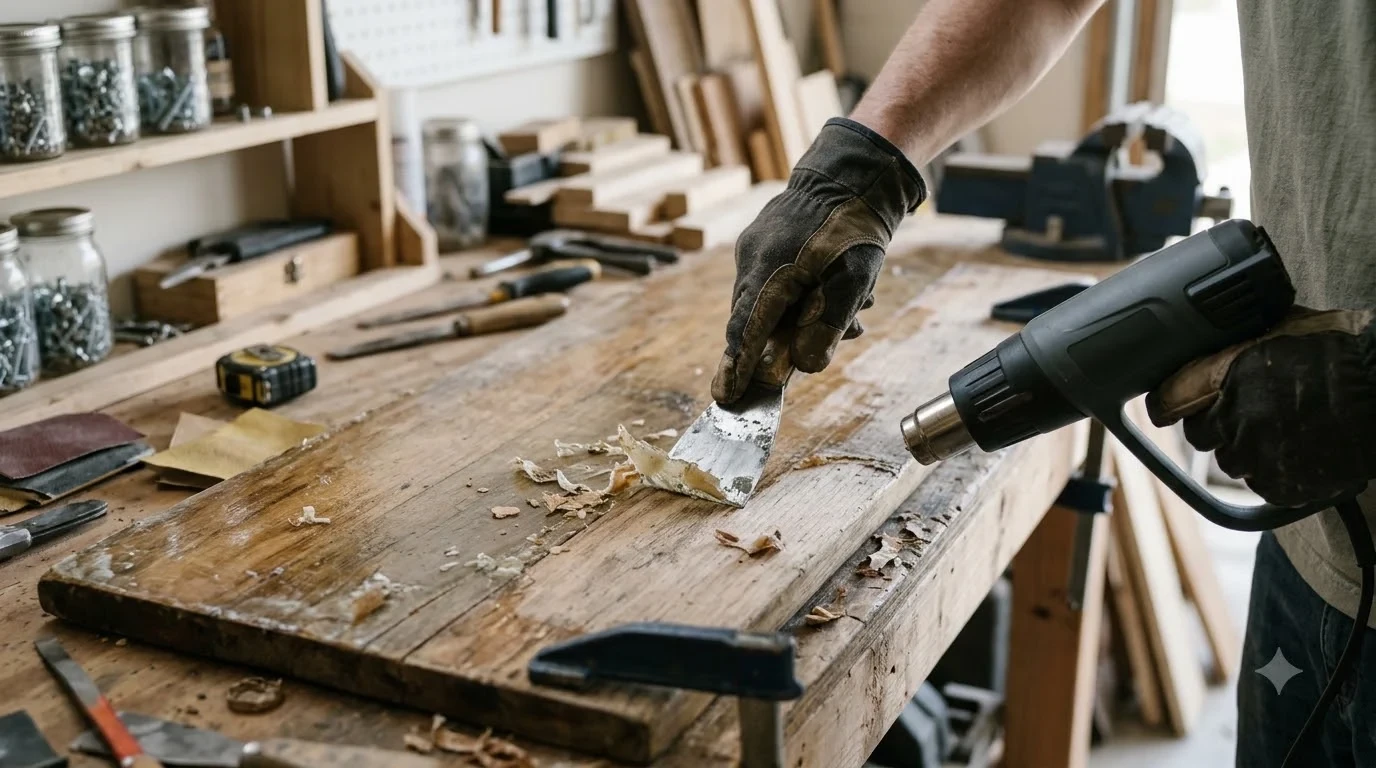
Acrylgiessen says hot air guns with temperature control are effective here, because epoxy usually softens from around 200 °C. UniBond recommends a heat gun at about 90 °C, aimed at small areas until the resin softens, then a plastic scraper. Dustless Blasting says heat guns are commonly used on cured epoxy in the range of 300°F to 500°F (150°C–260°C). These figures differ, so start at the low end, test a corner, and raise the heat only if the epoxy does not soften.
Work in small sections. Heat can transfer to the material underneath, and Entropy Resins warns that the surface beneath may be affected. Dustless Blasting also cautions that excessive heat can damage wood or plastic.
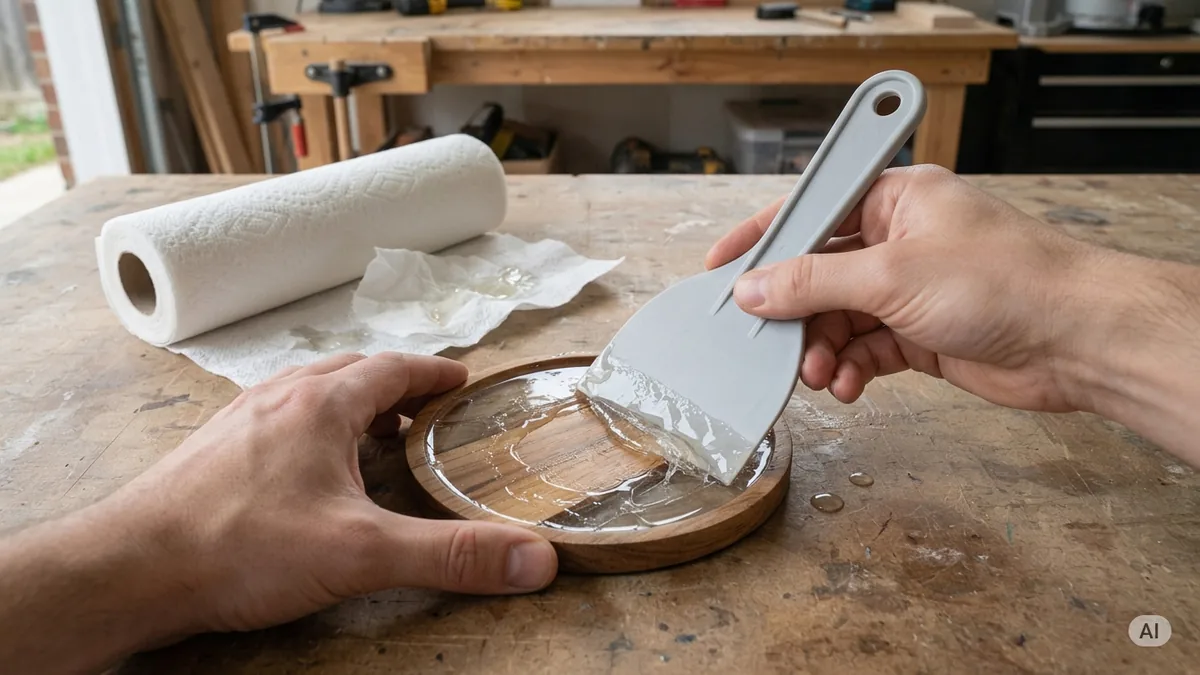
Sanding or grinding is the most efficient route for large cured areas, according to Entropy Resins. Dustless Blasting notes that a scarifier can leave a rough, uneven surface that often needs more sanding, so plan for a finishing pass. Use dust control and wear a dust mask, gloves, and goggles when you mechanically remove epoxy.
Solvents and Chemical Strippers to Use With Caution
Solvents can help with cured epoxy, but they work slowly and can damage surfaces. Treat them as a last step after heat and scraping, not as a quick fix.
Acrylgiessen says that for fully dry casting resin, the area must first be softened with paint thinner before treatment with ethanol. It also describes a universal thinner, made from denatured alcohol and paint thinner, as suitable for removing cured residue from surfaces. UniBond says acetone can be effective on wood or concrete, and Loctite recommends letting an acetone-dampened cloth soak for several minutes on porous materials before scraping with a putty knife.
Dustless Blasting lists solvents in order of increasing aggressiveness: acetone, toluene, MEK, sulfuric acid, and methylene chloride. The same source says methylene chloride is dangerous and intended for industrial use. Most home projects will not need anything beyond acetone or a paint thinner product.
Safety: Dustless Blasting warns that a heat gun should never be applied to surfaces that have acetone, paint thinner, or denatured alcohol on them, because of fire hazard. Wipe the area and let it dry fully before using heat. For more on this topic, see Can You Epoxy Over Wallpaper.
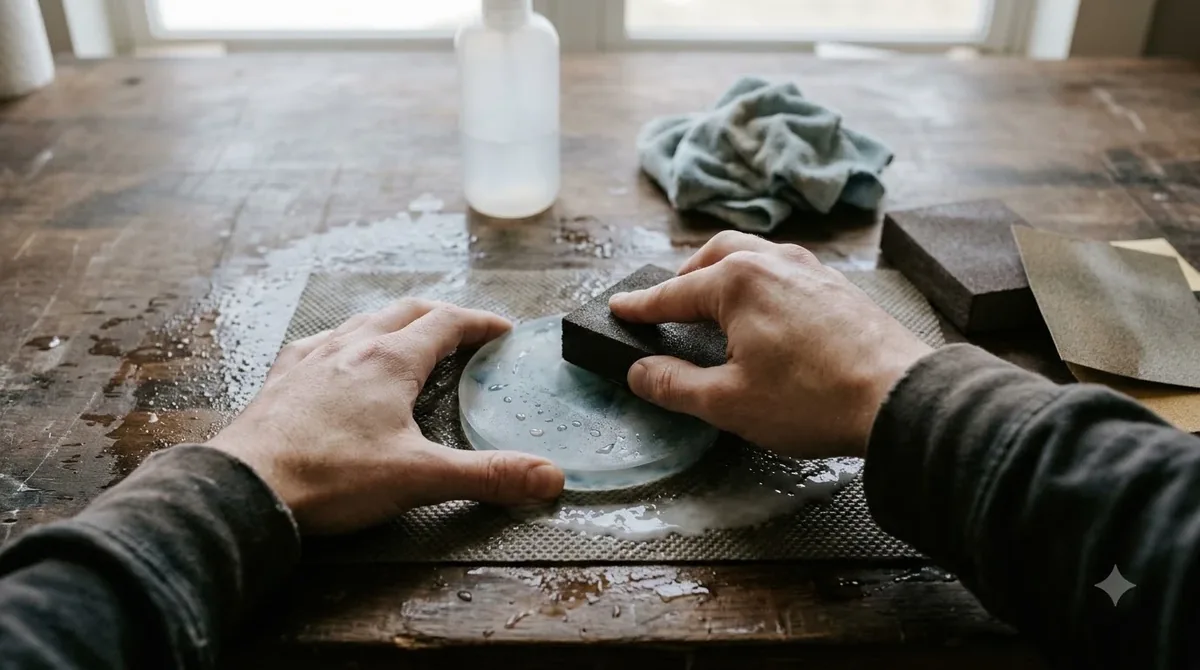
Check the product SDS for any solvent before use. Ventilate the room, keep open flames away, and wear gloves and eye protection, as Loctite recommends for solvent work. For a closer look at the heat-based approach, the UniBond epoxy removal guide lays out the 90 °C heat gun method step by step.
Removing Epoxy From Hard Surfaces and Skin Safely
Glass, metal, and wood each respond differently to removal. Smooth surfaces are easiest, while porous wood and concrete may hold residue. Pick the gentlest method that the surface allows.
For glass and plastic, Acrylgiessen says a cloth with an appropriate solvent or a chemical softener can lift residue, followed by scraping. For metal, Loctite describes a chemical adhesive remover to soften the epoxy, then chipping or scraping, and a final wipe with mineral spirits to remove any chemical residue. For wood and concrete, acetone and a scraper are the usual pairing.
For skin, follow the manufacturer’s safety guidance. Entropy Resins says never to use solvents to clean epoxy off skin. UniBond says vinegar works on both cured and uncured epoxy adhesive when applied to skin, and Loctite recommends a cloth dampened with isopropyl alcohol for hands. For more detail, see the skin removal steps, and check the SDS before you try any product on your body.
When to Stop and Start Over
Stop when a method damages the surface, when the epoxy will not soften after reasonable heat, or when you smell strong fumes you cannot control. Continuing can scorch wood, scratch glass, or leave a haze that is harder to fix than the original spill.
If the piece is valuable or the surface is structural, consider a professional or a full refinish instead. Sanding to a level finish may be the only practical fix for a thick cured layer. For more troubleshooting ideas, browse the Troubleshooting & Fixes section.
Frequently Asked Questions
What household items can remove uncured epoxy?
Acrylgiessen names isopropyl alcohol as the most suitable option for resin that has not completely cured. UniBond lists white vinegar and methylated spirit on a cloth as options before the epoxy dries. Wipe quickly, because the film hardens over time.
Is acetone safe to use for removing cured epoxy?
UniBond says acetone can be effective on wood or concrete for cured epoxy, but only in well-ventilated areas away from flammable objects. Loctite advises checking that acetone will not damage the finish first. Read the SDS before you start.
What temperature should a heat gun be set to for softening epoxy?
Sources give different figures. UniBond recommends about 90 °C, Acrylgiessen notes softening from around 200 °C, and Dustless Blasting cites 300°F to 500°F (150°C–260°C). Start low, test a corner, and increase only if the epoxy does not soften.
Can vinegar remove epoxy from skin?
UniBond states vinegar works on both cured and uncured epoxy adhesive when applied to skin. Entropy Resins, however, warns against using solvents on skin, so check the product SDS. Wash the area with soap and water afterward.
Start with the cure state, then move from the gentlest method to the stronger ones. Keep ventilation, gloves, and the product SDS in mind at every step, and if the job gets too large, consider a full refinish.
More in Troubleshooting & Fixes
 How to Fix Scratches in Epoxy Tables Without Redoing the Whole TopUpdated Nov 26, 2026
 How to Remove Amine Blush From Epoxy Without Starting OverUpdated Nov 26, 2026
 What Will Remove Epoxy from Wood, Metal, Skin and Hair SafelyUpdated Nov 26, 2026
 Paint and Epoxy Remover: Which Type Strips Cured Epoxy and Paint SafelyUpdated Nov 26, 2026
 Resin Sticking to Mold? Causes, Release Fixes and Safe RemovalUpdated Nov 26, 2026
 Why Is My Epoxy Bumpy? Causes and Fixes for a Smooth FinishUpdated Nov 26, 2026