

We may earn a commission when you buy through links on this page, at no extra cost to you. Learn more.
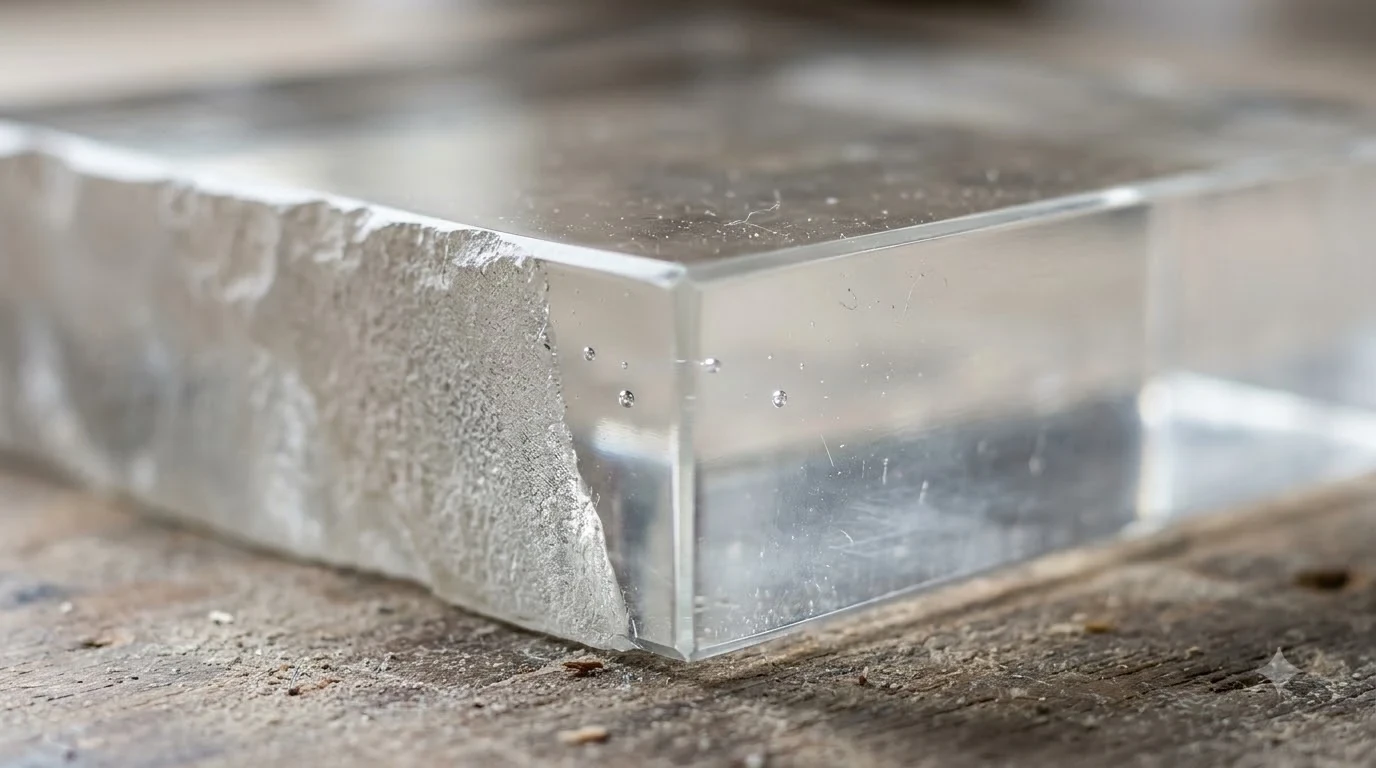
Deep pour vs table top epoxy comes down to how thick each layer can safely be poured. Table top epoxy is a coating resin that TotalBoat lists at about 1/8 to 1/4 inch per layer, while deep pour casting resins are built for much thicker single pours. TotalBoat’s Fathom Deep Pour is rated up to 3 inches deep in one layer, and UltraClear’s Deep Pour Epoxy is rated up to 2 inches per layer. Use table top for flat, glossy finishes and deep pour for castings, river tables and thick voids.
If you are planning a river table, a resin casting or a bar top, the wrong bottle can cause cracking, cloudiness or overheating. This guide compares the two types by layer depth, viscosity, cure time, heat build-up and project fit, so you can match the resin to the job. The figures below come from manufacturer and supplier pages. They are product-specific, so always confirm them against the label and technical data sheet for your exact resin.
What Is Deep Pour Epoxy?
Deep pour epoxy is a casting resin designed to cure in thick layers without generating dangerous heat. It is the type most DIYers reach for when a project is measured in inches rather than fractions of an inch.
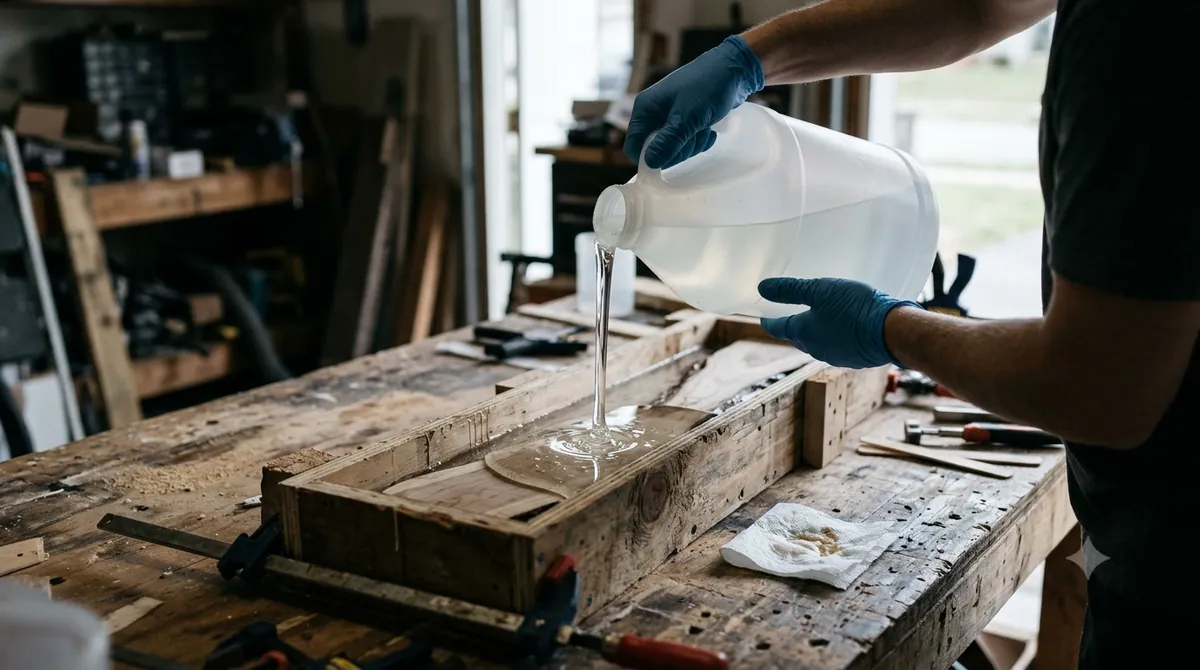
The chemistry is the key difference. Epoxy releases heat as it cures, and in a thin coat that heat escapes quickly. In a thick mass, the heat stays trapped, so deep pour formulas use a slower reaction. TotalBoat’s single-layer pour depth guide explains that casting epoxies can be poured deeper per layer than coating epoxies because they generate less heat per thickness or mass.
The trade-off is time. According to Jinhua’s deep pour resin review, a deep pour epoxy typically needs 48 to 72 hours before demolding and 7 to 14 days to reach full working hardness. Jinhua also recommends a viscosity in the 200 to 600 mPa·s range and at least 60 minutes of working time, ideally 90 to 120 minutes, for complex pours.
What Is Table Top Epoxy?
Table top epoxy is a self-leveling coating resin used on bar tops, counters, shelves and other sealed surfaces. It is built to spread into a thin, glossy layer and cure hard.
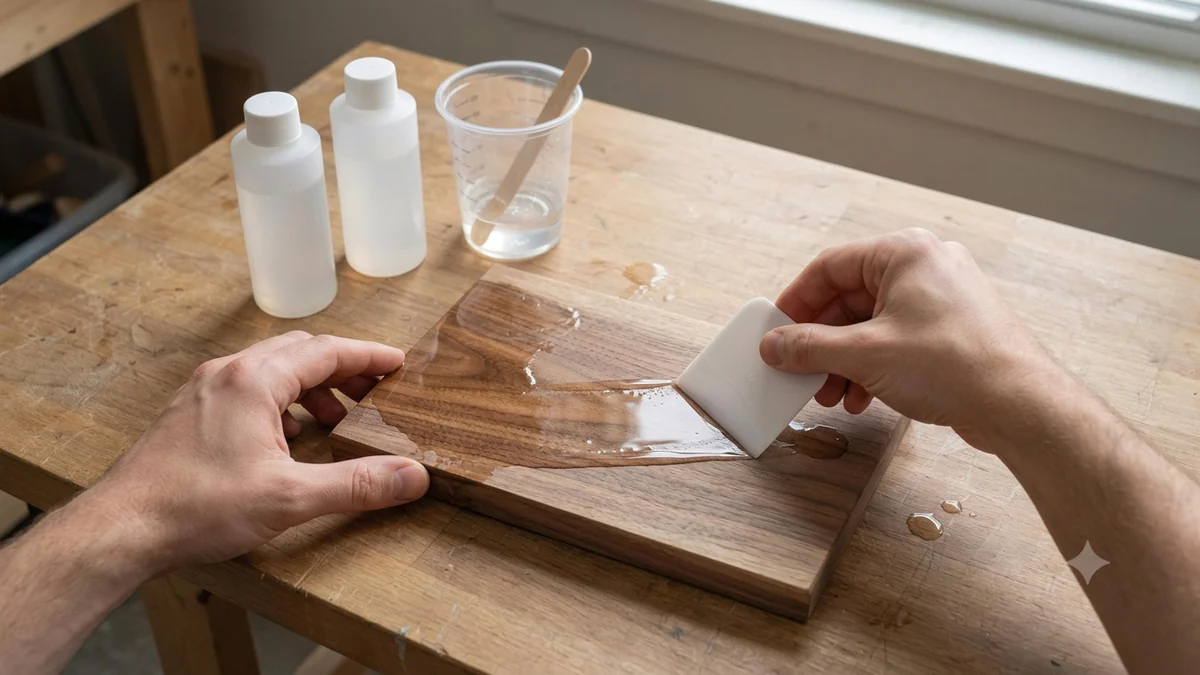
TotalBoat describes table top epoxy as a self-leveling coating epoxy with a quick recoat window of 3 to 6 hours and a cure within 24 to 72 hours. Its maximum pour depth is about 1/8 to 1/4 inch per layer, so a thicker build means several separate coats.
Table top resin is also not designed for outdoor exposure on its own. TotalBoat says it is not recommended outdoors without a UV-stable varnish or polyurethane topcoat, because long UV exposure can cause fading and discoloration. Treat it as a surface product, not a filler for a deep void. For more on this topic, see Can You Use Deep Pour Epoxy for Table Top.
Key Differences in Viscosity and Cure Time
The biggest practical gap is how long each resin stays workable and how fast it hardens. Deep pour gives you time to place objects and let bubbles rise, while table top sets quickly and leaves little room for correction.
| Factor | Deep pour epoxy | Table top epoxy |
|---|---|---|
| Typical maximum per layer | Often 2 to 4 inches, depending on the product | About 1/8 to 1/4 inch |
| Working time | Up to 4 to 6 hours for TotalBoat Fathom; about 6 hours at 77°F for POURLA Deep Pour | About 20 to 30 minutes at 75°F for POURLA Countertop Epoxy |
| Recoat window | Within 24 to 36 hours for POURLA Deep Pour without sanding | 3 to 6 hours for TotalBoat TableTop |
| Cure to demold or full cure | 48 to 72 hours to demold; 7 to 14 days to full working hardness | 24 to 72 hours for TotalBoat TableTop |
| Viscosity | Thinner flow that wraps around embeds; Jinhua cites 200 to 600 mPa·s | Runs slightly thicker, so it stays put on flat surfaces |
Deep pour’s longer working time is useful for embeds and color work, but it also means a longer wait before you can sand or handle the piece. Plan the calendar around the cure, not the pour. For the mixing side of this process, see kisrel deep pour epoxy resin instructions.
Table top moves quickly, which helps on a flat surface but leaves less time to fix problems. Once it begins to set, you cannot easily reposition objects or smooth a drip. Read the working time on your specific product before you mix a full batch.
Heat Build-Up and Bubble Risk
Heat is the reason the two types cannot swap roles. Pouring table top epoxy too deep traps heat in the center, which can cause bubbling, cracking, yellowing or smoke.
TotalBoat says excessive exotherm can shorten working time and ruin the finish with bubbles, cracking, yellowing, shrinkage and surface waves. It advises keeping the work area below 80°F and using air conditioners or cooling mats when needed. Its guidance also says to wait until each layer cools to room temperature, which it gives as 70 to 80°F, before pouring the next.
Temperature matters on both sides of the comparison. Jinhua recommends a 70 to 80°F window for most deep pour formulas, warns that cure slows below 65°F, and says the exotherm can overheat large pours above 85°F. UltraClear recommends a stable workspace between 70 and 75°F with low humidity.
Bubbles are a related risk. A low-viscosity deep pour lets air rise out of the mass, while a thick coat on porous wood can trap air. Seal porous wood first with a thin seal coat, as Jinhua advises, so air does not escape through your pour.
Tip: Check the room temperature and the resin temperature before you mix. A cold shop slows the cure, and a warm room speeds it up, so the same product can behave differently from one day to the next.
Cost, Coverage and Project Fit
Cost depends on volume, not on the label. Measure the cavity before you buy, because a kit sized for a thin coat will not fill a river channel, and a table top kit will not fill a deep void.
Start by measuring total volume. POURLA’s epoxy thickness guide says depth alone does not tell the whole story, since a large river channel holds much more reactive mass than a small mold at the same depth. For an irregular live edge, measure the width at regular intervals and average the readings. POURLA’s calculator adds a 5% planning buffer, which is a useful reference when you estimate how much to mix.
A wrong choice costs more than the bottle. Jinhua notes that using table top epoxy for deep pours can ruin an expensive live edge slab or mold. Covering a large surface with table top also means several thin passes, so budget time as well as material. Background on this topic is covered in Deep Pour Epoxy Ideas.
When to Use Each Type
Choose by the deepest point of the project, not by the surface you can see. If any single pour needs to be thicker than about a quarter inch, you are in deep pour territory.
- Table top epoxy: bar tops, counters, dining tables, small resin crafts, trays and a final gloss coat.
- Deep pour epoxy: river tables, thick castings, embedded objects, wood voids and large molds.
- Both: a river table often uses deep pour for the channel fill, then a table top flood coat over the cured surface for hardness and gloss.
River tables need the closest look at limits. TotalBoat lists ThickSet at 1/2 inch for river pours, while its Fathom product can go up to 2 inches for river tables, with layers at least 1 inch deep. POURLA warns that a small opening can hide a large resin mass below, so measure the deepest point, not just the visible width.
Common Mistakes and How to Avoid Them
Most failed pours come from a few predictable errors. Each one has a simple check you can make before you mix.
- Pouring table top too deep. Stay within the per-layer limit and step-pour the rest.
- Using deep pour as a thin topcoat. Deep pour cures slowly, and Jinhua notes that if it is poured too thin it may not cure at all.
- Skipping the wood seal. Porous slabs release trapped air into the pour.
- Recoating on the wrong schedule. TotalBoat advises checking that you can indent a fingernail in the curing layer before pouring the next one.
- Mixing off-ratio. Measure by volume, because off-ratio mixing leads to surfaces that stay tacky.
If a pour goes wrong and the surface is sticky or distorted, TotalBoat’s repair method is to scrape off as much as you can, wipe with acetone, sand with 220 to 320 grit paper, then pour a new layer within the limit. Do not brush extra hardener over a soft area, because POURLA says that is not a fix. If this section raised more questions, How Long for Deep Pour Epoxy to Cure may answer them.
Safety Gear and Ventilation
Both resin families are two-part chemical systems, so the same basic protection applies to each. Read the product SDS before you open a container.
Wear nitrile gloves and eye protection, and work in a ventilated space. Check the SDS for the respirator type it recommends if you sand or work in an enclosed area. POURLA advises that if a pour becomes unusually hot or gives off smoke, you should stop work, keep people away from the hot material and fumes, follow the SDS emergency guidance, and not add another layer.
Keep the area clean and dry, and cover the pour loosely to keep dust off the surface. Jinhua notes that a full plastic cover can hold heat in, so a simple cardboard tent is the gentler option.
Safety: Wear gloves and work with good airflow. If a pour overheats or smokes, step away and follow the product SDS.
Frequently Asked Questions
How thick can I pour epoxy in one layer for a river table?
It depends on the product. TotalBoat lists ThickSet at 1/2 inch for river pours, while its Fathom product can go up to 2 inches for river tables and slab pours. UltraClear rates its Deep Pour Epoxy up to 2 inches per layer. Check the technical data sheet for the exact resin you bought.
Can I use tabletop epoxy for a deep pour?
No, not in a single thick pour. Table top epoxy cures too quickly for thick applications, and TotalBoat’s comparison says it can overheat, crack or smoke. Its per-layer limit of about 1/8 to 1/4 inch means a deep casting would need many separate layers.
How long does deep pour epoxy take to cure before I can demold it?
Jinhua says deep pour epoxy typically needs 48 to 72 hours before demolding and 7 to 14 days to reach full working hardness. POURLA’s product reaches an initial cure in 36 to 48 hours at 77°F and maximum hardness in 3 to 5 days. Cooler rooms can extend those times, so wait longer if the piece still feels soft.
Does deep pour epoxy yellow in sunlight, and do I need a UV topcoat?
Jinhua says a deep pour epoxy will eventually yellow in UV light without protection. Built-in UV inhibitors protect the full depth of the cast, while a topcoat only protects the surface. If the spec sheet does not mention UV resistance, assume it was not a formulation priority.
Match the resin to the deepest point of your project, then confirm the layer limit on the label before you mix. To learn the terms you will see on data sheets, read Resin Basics & Q&A.
More in Resin Basics & Q&A
 What Is Vacuum Degassing for Epoxy Resin and How It Removes Trapped BubblesUpdated Nov 26, 2026
 Epoxy Full Cure Time: How Long Before Your Project Is Ready to UseUpdated Nov 26, 2026
 Envirotex Lite Pour On Instructions for a Glossy, Bubble-Free FinishUpdated Nov 26, 2026
 High Temperature Epoxy for Metal: How to Pick One That Holds Up to HeatUpdated Nov 26, 2026
 Amazing Clear Cast Resin Instructions: Mix, Pour and Cure Without BubblesUpdated Nov 26, 2026
 How Long for Deep Pour Epoxy to Cure: Demold and Full-Cure Times ComparedUpdated Nov 26, 2026