

We may earn a commission when you buy through links on this page, at no extra cost to you. Learn more.
The MAS Epoxies resin calculator estimates how much mixed epoxy you need by turning your surface size and coating thickness into a volume. According to MAS, a 1-gallon Table Top Pro kit covers about 12 square feet at a 1/8 inch flood coat. Deep Pour Epoxy uses a 3:1 mix by volume and pours 1/2 to 1 inch per layer at 70°F. Run the numbers before you buy, then add 5-10% for waste.
This guide walks through how to use the calculator’s inputs, which MAS mix ratios matter for each product, and how to size an order for a tabletop, a deep pour, or a floor. It also covers the sizing mistakes that leave makers short halfway through a pour.
How the MAS Epoxies Resin Calculator Works
The calculator solves a volume problem. You give it the footprint of your piece and the finished thickness of the epoxy, and it returns the amount of mixed material needed. Mixed material is the resin and hardener combined, so you do not need to add the two parts separately.
Coverage depends on more than geometry. MAS notes that coverage can depend on coating thickness, porosity of the surface, and waste. The calculator gives you the starting point, and the surface and your mixing habits change the final number.

Entering Your Project Size and Thickness
Accurate inputs matter more than the calculator itself. Measure the length and width in inches, and convert any fractions to decimals before you enter them. A 1/8 inch thickness should be entered as 0.125.
For a round surface, measure the diameter and use the radius, which is half the diameter. TotalBoat’s epoxy coverage calculator page describes the same steps for round tops: square the radius, multiply by pi and the thickness, then convert the cubic inches to ounces. The epoxy calculator on this site follows the same logic, so you can cross-check a result from either tool.
Thickness is the input that changes the answer most. Doubling the depth doubles the volume, so a 1/4 inch coat needs twice the epoxy of a 1/8 inch coat over the same surface.
Mix Ratios for Common MAS Epoxies Products
Each MAS product has its own ratio, and the calculator only gives you the total volume. You still have to split that total into resin and hardener using the ratio printed for your product. Mixing the wrong ratio is one of the most common causes of soft or sticky cures.
| MAS product | Mix ratio | Key limit from the source | Sanding or cure note |
|---|---|---|---|
| Table Top Pro | 1:1 by volume (100 parts resin to 83 parts hardener by weight) | 1/8 to 1/4 inch per coat; 70-80°F working range | Sandable after 24 hours at 75°F |
| Deep Pour Epoxy | 3:1 by volume | 1/2 to 1 inch per pour at 70°F; do not use above 75°F | Sand or machine after 24-48 hours |
| 2:1 Premium Marine LV Resin | 2:1 by volume | Working time of 10, 25, or 40 minutes depending on hardener | Full cure in about 2 to 5 days at 75°F |
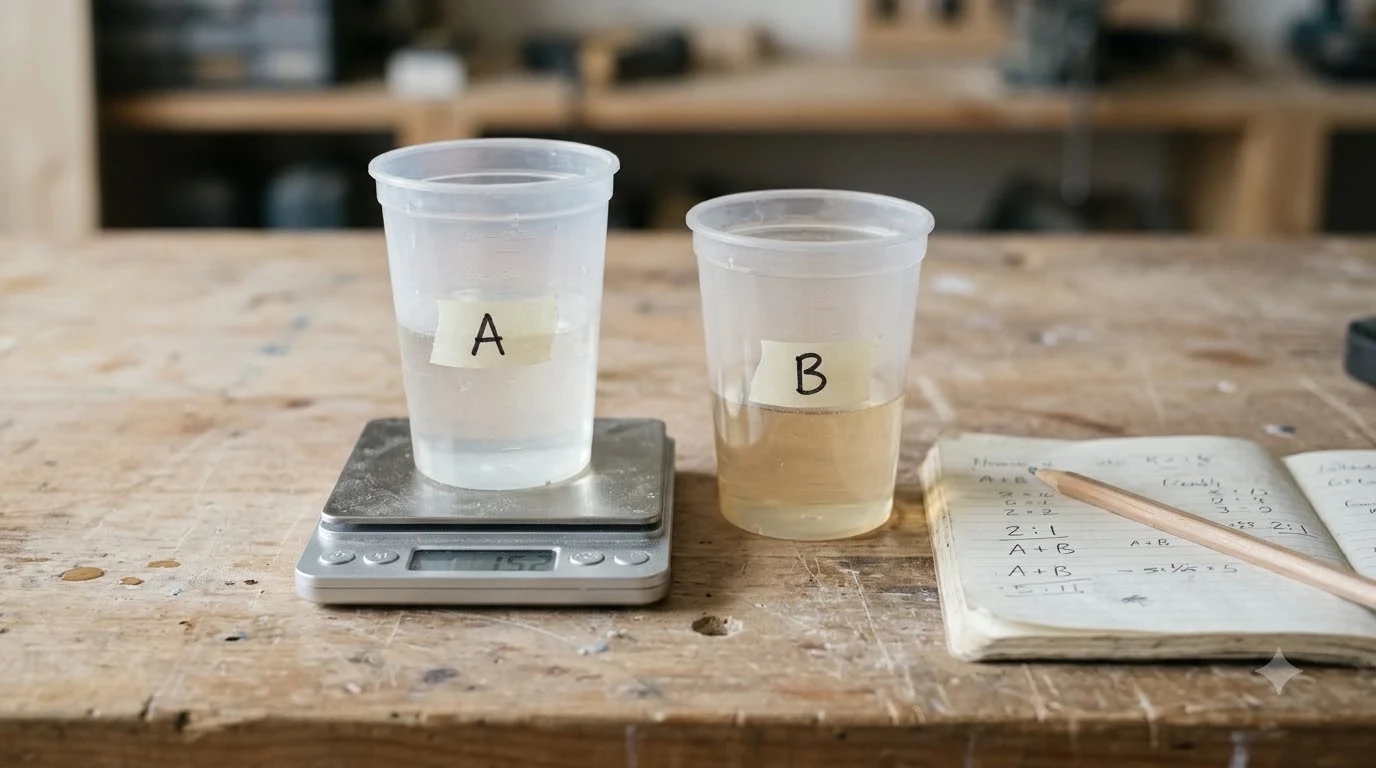
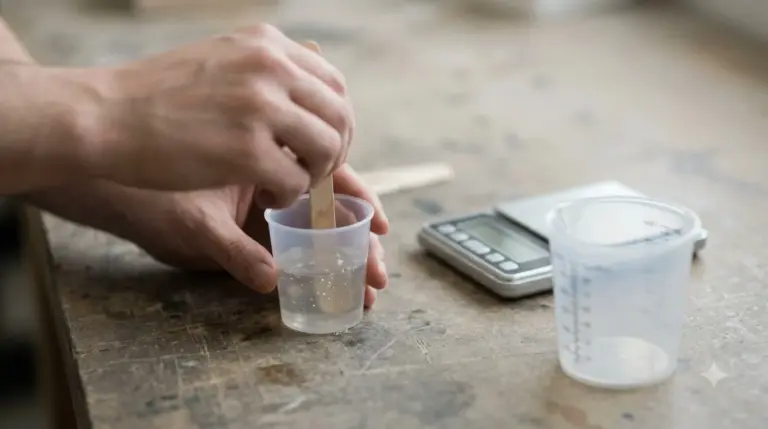
For Table Top Pro, the volume ratio is the one you measure with cups. The weight ratio is useful if you have a scale, but MAS says not to deviate from the recommended ratio to speed up or slow down gel time. For Deep Pour Epoxy, a 3:1 volume ratio means three parts resin for every one part hardener, so a 40 ounce mixed total splits into 30 ounces of resin and 10 ounces of hardener.
Estimating Coverage for Tabletops, Pours, and Floors
Coverage changes with thickness, so the same gallon covers very different areas. The table below uses the MAS figure of 12 square feet per 1-gallon Table Top Pro kit at 1/8 inch as the reference point, then applies the source formula to thicker coats. The results are arithmetic from the source conversion factors, not separate MAS claims.
| Coating thickness | Fluid ounces per square foot | Total for 12 square feet | Practical take |
|---|---|---|---|
| 1/8 inch | About 10 fl oz | About 0.94 gallon | Matches the MAS 1-gallon kit figure |
| 1/4 inch | About 20 fl oz | About 1.87 gallons | Needs at least two 1-gallon kits |
| 1/2 inch | About 40 fl oz | About 3.74 gallons | Table Top Pro is not rated for this in one coat; use Deep Pour |
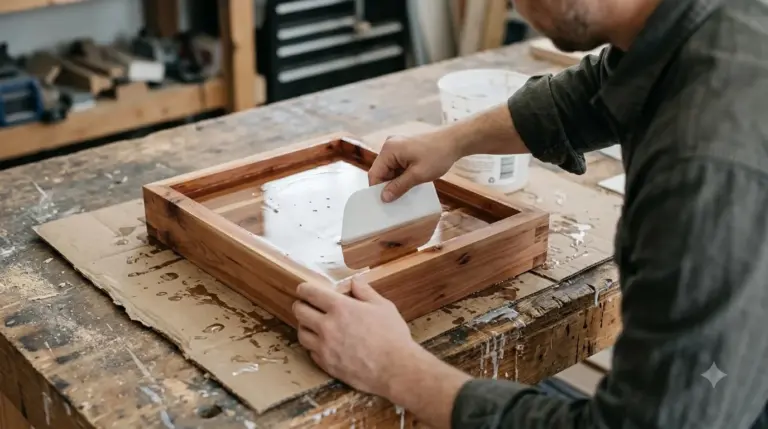
Tabletops are the simplest case because the MAS Table Top Pro flood coat is applied in thin layers. MAS also describes a typical sequence of one seal coat followed by one flood coat. Plan for both, since the seal coat uses epoxy too.
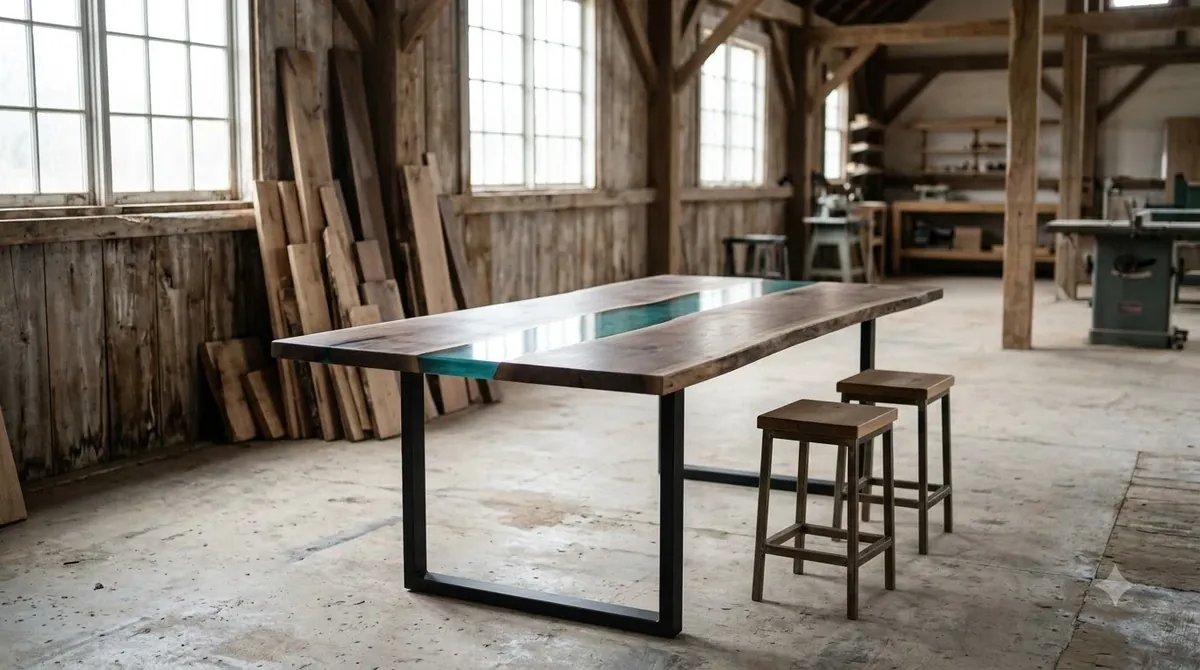
Deep pours work differently. Deep Pour Epoxy is rated at 1/2 to 1 inch per pour at 70°F, so a thick river table needs several separate pours. MAS says thicker castings are achieved through multiple pours, and the calculator should be run once per layer so each batch stays within the rated depth.
Floors are the least specific case in the sources. None of the MAS pages reviewed give floor coverage figures for these products. Check the technical data sheet for your exact product, and do not assume a tabletop coverage number applies to a floor.
Calculating Material Cost Before You Buy
Once you have a volume, convert it into kits. A 1-gallon Table Top Pro kit contains a half gallon of resin and a half gallon of hardener. A half-gallon kit covers about 6 square feet at 1/8 inch, according to MAS, so a 12 square foot top needs two half-gallon kits or one 1-gallon kit with room to spare.
Compare cost per gallon across sizes rather than the price per kit. The Table Top Pro page lists 2-quart, 1-gallon, 2-gallon, and 4-gallon sizes, so the right size depends on how much area you have to cover. For a fuller breakdown of budgeting, see how much does epoxy cost.
Add the cost of spreaders, cups, sandpaper, and protective gear to the material total. Those items do not change with the calculator result, but they often make up a noticeable share of a small project.
Common Sizing Mistakes to Avoid
The most frequent error is calculating the top surface and forgetting the edges. The TotalBoat calculator notes that the basic formulas do not account for epoxy that runs over the edges. If you let epoxy drip over the sides, add more material.
- Skipping the waste allowance. TotalBoat advises adding 5-10% for epoxy left on the stir stick, in the cup corners, or in drips.
- Using the wrong thickness unit. Entering 1/8 as 1/8 in a field that expects a decimal can distort the result.
- Forgetting the seal coat on wood or other porous surfaces. MAS says a seal coat is typical before a flood coat, and it adds material.
- Mixing one large batch for a big job. MAS says not to mix more than one gallon at a time, so split large orders into several batches.
Deep pours carry their own sizing trap. Pouring too much epoxy into a large void can cause shrinking, yellowing, or cracking, according to MAS. Divide the total volume into layers that stay within the rated depth instead of filling the mold in one step.
Frequently Asked Questions
How do I use the MAS Epoxies resin calculator to figure out how much epoxy I need?
Enter the length and width in inches, and the finished thickness as a decimal. The calculator returns the mixed volume, which you can convert to ounces by dividing cubic inches by 1.805. Then add 5-10% for waste, following the TotalBoat guidance for table top pours.
What is the mix ratio for MAS Deep Pour Epoxy?
MAS Deep Pour Epoxy is a two-component system with a 3:1 mix ratio by volume. The manufacturer part number is 30-420, and Rockler sells the product under item number GRP40942. Check the product instructions to confirm the ratio for your batch size.
Can I mix MAS 2:1 LV resin with 5:1 marine epoxy?
No. MAS states that the 2:1 LV resin and hardeners cannot be mixed with the 5:1 traditional marine system, because they are different ratios and systems. Keep the two product lines separate in your workspace and label each container so you do not swap parts during a pour.
Do I need a seal coat before pouring MAS epoxy on wood?
MAS recommends a seal coat on wood or other porous surfaces, and the MAS Table Top Pro FAQ says to sand the cured seal coat with 80-120 grit paper. For Deep Pour Epoxy, MAS suggests sealing porous surfaces with Penetrating Epoxy Sealer to reduce the risk of air bubbles and foam during cure.
Use the calculator as your starting volume, then confirm the thickness, ratio, and waste allowance for your product before you mix. If you are comparing sizes or budgets, the Calculators & Coverage section collects other sizing guides for this site.
More in Calculators & Coverage
 How Much Deep Pour Epoxy Do I Need? Calculate Gallons and Kits From Your Mold SizeUpdated Nov 26, 2026
 How to Measure Epoxy Resin and Hardener by Weight or VolumeUpdated Nov 26, 2026
 How Much Does UV Resin Cost Per Ounce and Per Project?Updated Nov 26, 2026
 Cost of a Gallon of Epoxy Resin and How Far One Gallon GoesUpdated Nov 26, 2026
 How Much Does Epoxy Cost? Gallon Prices and Project BudgetsUpdated Nov 26, 2026
 Epoxy Calculator: How Much Resin Your Project Really NeedsUpdated Nov 26, 2026