

We may earn a commission when you buy through links on this page, at no extra cost to you. Learn more.
For most resin work, the best what type of respirator for resin answer is a mask with organic vapor (OV) cartridges, plus a P100 particulate filter if you also sand or spray. A dust mask or N95 blocks particles but not the vapors released while you mix and pour. According to PK Safety, the 3M 6001 is an organic vapor cartridge commonly used when working with epoxy resin. WC Safety recommends an OV/P100 combination cartridge as the best all-around choice for epoxy because it covers both vapor and dust.
Resin creates two different airborne hazards, and they need two different kinds of filtering. This guide explains which respirator type matches each task, how to choose between half-mask and full-face models, and how to keep the setup working safely. It also covers the habits that matter as much as the gear itself.
What Respirator Do You Need for Resin?
Most resin tasks need an organic vapor cartridge. Mixing, pouring, casting, and curing all release vapors from the resin, the hardener, and any reactive diluents. Sanding cured resin is a separate dust hazard that calls for a P100 particulate filter.
WC Safety states that the main inhalation hazard from epoxy is organic vapor, and that a P100 or N95 alone does not protect you from it. Resiners makes the same point: dust masks and N95s block particles but not resin fumes. So a respirator for resin usually means a vapor cartridge first and a particulate filter second.
Many people ask whether a respirator is needed for small art projects. The answer depends on how much you mix, how warm the room is, and how well it is ventilated. Resiners notes that even formulas labeled low-VOC can emit vapors that irritate the lungs. Check the Safety Data Sheet (SDS) for your specific product, since Section 8 lists the recommended respiratory protection.
Why Resin Fumes Need More Than a Dust Mask
Dust masks are built to catch solid particles, not gases. Resin fumes are gas-phase vapors, so they pass straight through a particulate filter. Understanding that difference is the key to choosing the right respirator.
Wikipedia explains that chemical cartridges remove gases and vapors through adsorption, absorption, or chemisorption. The sorbent in the cartridge, usually activated carbon, captures the vapor molecules. Over time that sorbent saturates and stops working.
A cartridge also has no reliable alarm. Wikipedia notes that many harmful gases have no warning properties, so smell is not a dependable end-of-service signal. WC Safety adds that people can become desensitized to an odor, which is why you should replace cartridges on a schedule rather than waiting to notice a smell.
- Vapors from resin and hardener: need an organic vapor cartridge.
- Cured-resin sanding dust: needs a P100 particulate filter.
- Spraying or mist: needs both vapor and particulate protection.
Organic Vapor Cartridges vs. P100 Filters
Organic vapor cartridges and P100 filters do different jobs, and one does not replace the other. Choosing the wrong one leaves you unprotected even though the mask fits well.
PK Safety describes the 3M 6001 as an organic vapor cartridge filled with activated charcoal, widely used for boat work because it picks up vapors from epoxy resin, 5200 adhesive, and penetrating epoxy. The 6001 has no dust filter, so it is a poor choice for sanding. WC Safety lists it as the right pick for mixing and pouring when no dust is present.
P100 filters work the other way. WC Safety states that P100 captures 99.97% of particles, compared with 95% for N95, and resists oil-based resin mist. That makes a P100 strong for dust, but it does nothing against vapor. The 3M 2091 is a P100-only option that WC Safety lists for sanding cured epoxy.
The OV/P100 combination covers both hazards in one cartridge. WC Safety recommends the 3M 60921 and the Honeywell North 7581P100L for this reason. PK Safety adds that the 3M 60926 combines a multi-gas cartridge with a P100 filter, but it costs about twice as much as a standard cartridge and makes each breath harder to pull.
Tip: If you cannot tell whether a job makes vapor, dust, or both, choose an OV/P100 cartridge. It covers the full range of resin tasks with one set of cartridges.
Half-Mask vs. Full-Face Respirators
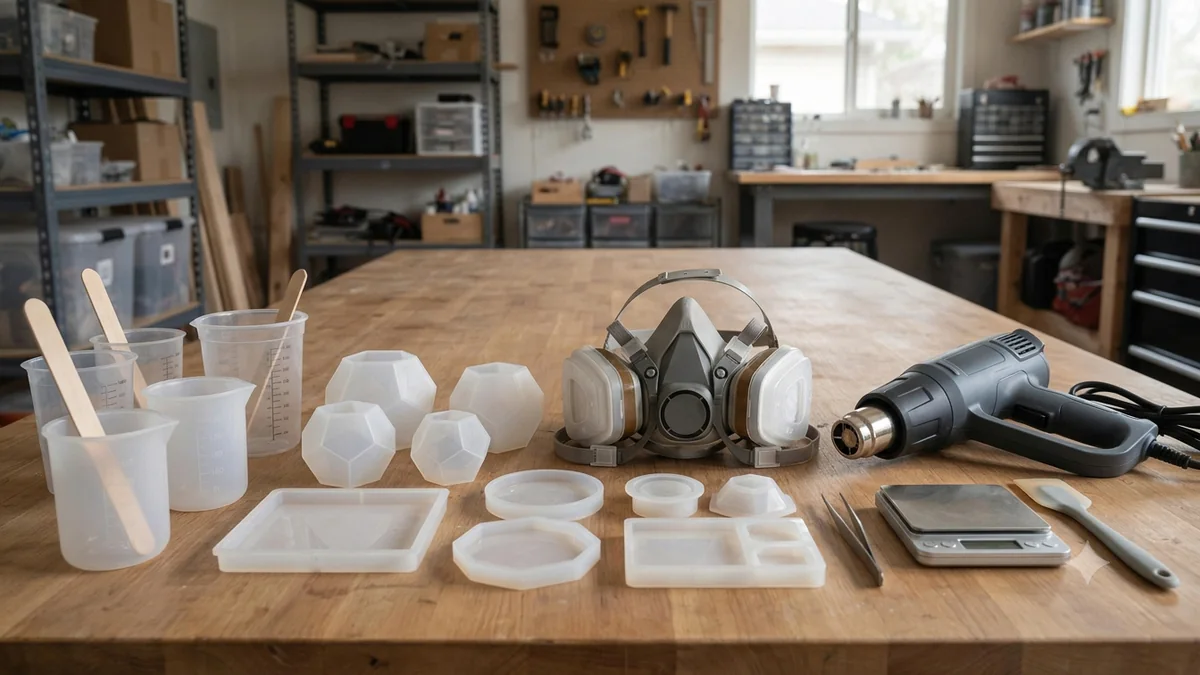
Half-mask and full-face respirators can use the same cartridges, so the choice comes down to coverage and comfort. A half-mask covers the nose and mouth. A full-face model also protects the eyes and face.
WC Safety gives a half mask an assigned protection factor (APF) of 10 and a full-face respirator an APF of 50. Both accept the same cartridges. A half-mask paired with separate safety glasses or goggles is a common setup for mixing and casting at home.
A full-face model makes more sense for spraying, large or heated pours, and enclosed spaces. WC Safety notes that a full face also protects the eyes from vapors and splashes. The tradeoff is weight and a larger facepiece to fit, so check comfort before a long session.
- Small casts and coasters: a half-mask with OV or OV/P100 cartridges plus eye protection.
- Spraying or large pours: a full-face respirator with OV/P100 cartridges.
- Long or repeated sessions: consider comfort and breathing effort before choosing.
How to Choose by Task
Start with the task you are doing today, not the product you already own. A quick task-to-cartridge match prevents most mistakes. Use the table below as a starting point, then confirm against the resin’s SDS.
| Task | Main hazard | Cartridge type |
|---|---|---|
| Mixing and pouring epoxy, no dust present | Organic vapor | OV only (for example, 3M 6001) |
| Casting or art resin, with later sanding | Vapor, then dust | OV/P100 (for example, 3M 60921) |
| Sanding cured resin only | Particulate | P100 (for example, 3M 2091) |
| Spraying resin or coating | Vapor and mist | OV/P100, full-face recommended |
| Fiberglass or river table work | Vapor and fiberglass dust | OV/P100 |
For fiberglass and composite work, WC Safety says a P100 alone is enough only for sanding fully cured glass with no fresh resin in the air. Once resin, gel coat, or epoxy is present, you need an organic vapor cartridge as well. Styrene from polyester resin and gel coat is an organic vapor that a particulate filter cannot capture.
Safety: Wear nitrile gloves rather than latex, keep resin off your skin, and ventilate the work area. Resiners recommends nitrile because it resists chemicals better than latex. Follow the SDS for your product.
Fit, Storage, and Cartridge Replacement
A respirator only works if it seals to your face and your cartridges are still active. Fit and replacement are the two habits that most often get skipped. Both matter as much as choosing the right cartridge.
WC Safety cites OSHA 1910.134(f), which requires fit testing of tight-fitting respirators in workplace settings. Hobbyists are not bound by that rule, but a basic seal check before each session is still wise. Close the mask, breathe in and out, and confirm no air leaks around the edges.
Resiners says organic vapor cartridges usually last a few hours, depending on how much resin you use and the air quality. Replace them when you smell fumes or when breathing feels harder. For workplaces, OSHA 29 CFR 1910.134(d)(3) requires a documented change-out schedule based on manufacturer service-life data.
PK Safety suggests replacing opened cartridges older than six months, or sooner if the manufacturer gives a shorter expiration. Store the respirator and spare cartridges in a sealed, airtight bag between sessions. For details on your specific cartridge, see the 3M respirator mask guide for epoxy resin. For the cartridge color and hazard breakdown behind these choices, see PK Safety’s 3M cartridge guide.
Frequently Asked Questions
Is a P100 or N95 enough for sanding cured epoxy?
A P100 or N95 works for dust from sanding cured epoxy, but it does not stop vapors. WC Safety lists the 3M 2091, a P100-only filter, as an option for sanding dust. Sanding alone is a particulate task, so a P100 is the better match than an N95.
What is the difference between a 3M 6001 and a 60921 cartridge?
The 3M 6001 is an organic vapor cartridge with no dust filter. The 3M 60921 is an OV/P100 combination that adds a particulate filter. WC Safety suggests the 6001 for mixing and pouring without dust, and the 60921 when sanding or spraying is also part of the job.
Does a half-face respirator protect against epoxy fumes?
Yes, a half-face respirator with organic vapor cartridges protects against epoxy fumes when it seals well. WC Safety gives half masks an APF of 10. It does not protect the eyes, so pair it with safety glasses or goggles during mixing and pouring.
Are N95 masks safe for resin fumes?
No. Resiners states that N95 masks block particles but not resin fumes, and surgical or cloth masks do not block epoxy fumes either. An N95 can be useful for dust, but resin vapors need an organic vapor cartridge in a respirator.
Choosing the right respirator for resin comes down to matching the cartridge to the task. Start with an organic vapor cartridge for mixing and pouring, and add P100 when you sand or spray. For more on epoxy-specific cartridges, read the Resin Basics and Q&A page or compare epoxy vs polyurethane before choosing a finish. Ventilate, wear nitrile gloves, and follow your SDS every time.
More in Resin Basics & Q&A
 What Is Vacuum Degassing for Epoxy Resin and How It Removes Trapped BubblesUpdated Nov 26, 2026
 Epoxy Full Cure Time: How Long Before Your Project Is Ready to UseUpdated Nov 26, 2026
 Envirotex Lite Pour On Instructions for a Glossy, Bubble-Free FinishUpdated Nov 26, 2026
 Deep Pour vs Table Top Epoxy: Which Fits Your Project Depth and Cure TimeUpdated Nov 26, 2026
 High Temperature Epoxy for Metal: How to Pick One That Holds Up to HeatUpdated Nov 26, 2026
 Amazing Clear Cast Resin Instructions: Mix, Pour and Cure Without BubblesUpdated Nov 26, 2026