

We may earn a commission when you buy through links on this page, at no extra cost to you. Learn more.
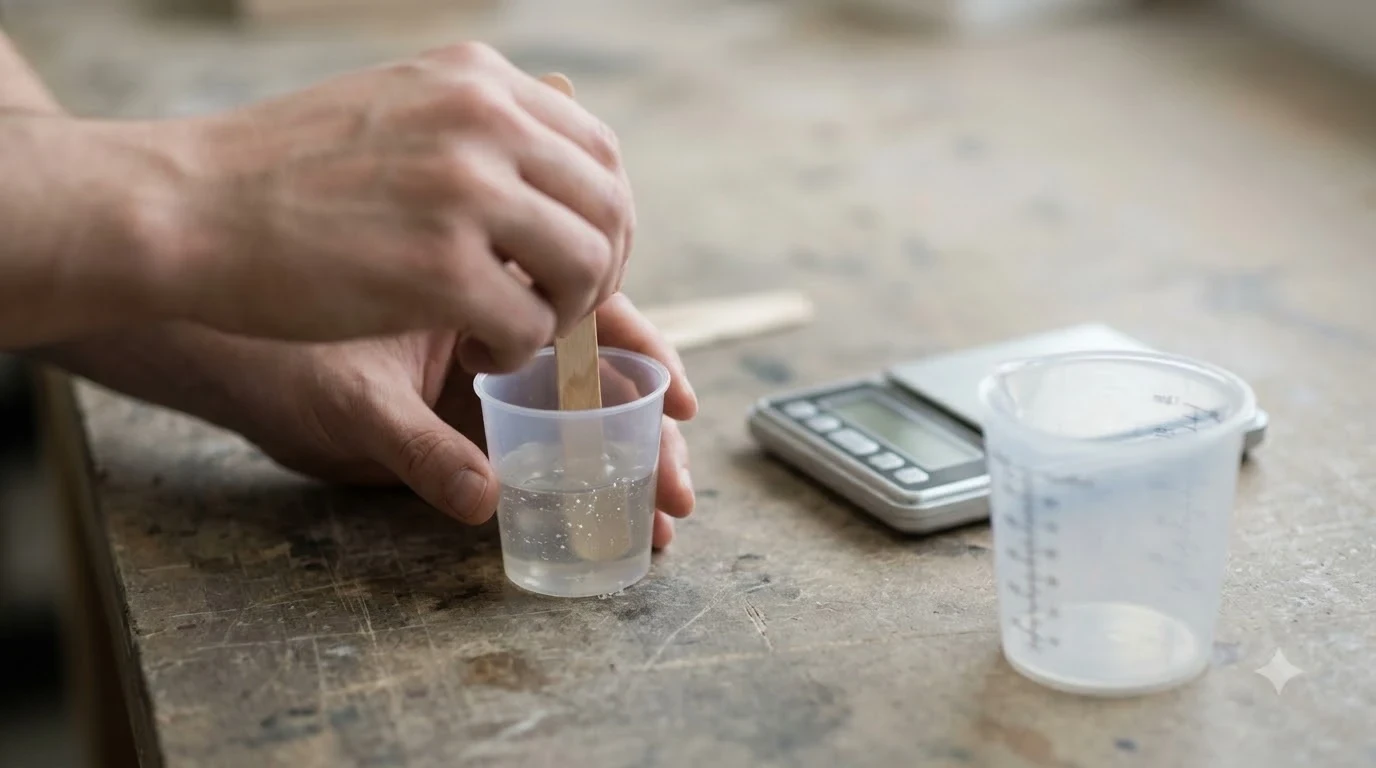
To measure epoxy correctly, weigh or measure the resin (Part A) and hardener (Part B) in the exact ratio on the product label or data sheet. Most epoxy systems use a ratio such as 1:1, 2:1, 3:1 or 5:1, with the first number for resin. Weight ratios differ from volume ratios because the two parts have different densities, so a 1:1 volume ratio may be about 100:83 by weight. Measure both parts in one clean, sturdy container, and mix for the time the manufacturer lists. Learning how to measure epoxy this way helps the batch cure fully.
Measuring is the step that decides whether epoxy cures hard and clear or stays tacky. Errors are common, and most cure problems trace back to the ratio. This guide walks through the tools you need, how to read a mix ratio, how to measure by weight or by volume, how to mix without trapping air, and how to plan a batch size before you start.
What You Need to Measure Epoxy Accurately
You need the right tools before you open any bottles. Gather the product data sheet, a measuring method you can repeat, a clean mixing container and a stir stick. The table below lists the basics.
| Item | What it is used for | What to look for |
|---|---|---|
| Product data sheet or label | Confirms the mix ratio and whether it is measured by weight or volume | Both the volume ratio and the weight ratio, if the maker lists them |
| Digital scale | Weighs resin and hardener in grams | Readings in 0.1 gram steps for small batches, according to System Three |
| Graduated mixing cup | Measures by volume | Clear markings that match the ratio you need |
| Sturdy plastic mixing container | Holds the mixed batch | Wide bottom and thick walls, not thin disposable beverage cups |
| Stir sticks and nitrile gloves | Mixing and handling | Clean, dedicated tools that will not add dust or residue |
Check the temperature of your workspace and your materials, too. According to TotalBoat, most epoxy systems cure best between 60 and 90°F. Cold resin is thick and hard to measure, so TotalBoat suggests warming a closed container in a warm water bath, around 90 to 100°F, for 10 to 15 minutes. Never use a heat gun or microwave to warm it.
Understanding Epoxy Mix Ratios
A mix ratio tells you how much resin to combine with how much hardener. The resin is always the first number. A 2:1 ratio means two parts resin for every one part hardener, and a 1:1 ratio means equal parts. Some labels write the ratio as 1A:1B to show which part is which.
The ratio also tells you how to measure. A ratio is usually given by volume, by weight, or both. Because resin and hardener have different densities, the weight ratio is not the same as the volume ratio. A 1:1 volume ratio may be about 100:83 by weight. System Three says a 2:1 volume ratio is often equivalent to about 100:43 by weight, because the hardener is less dense than the resin.
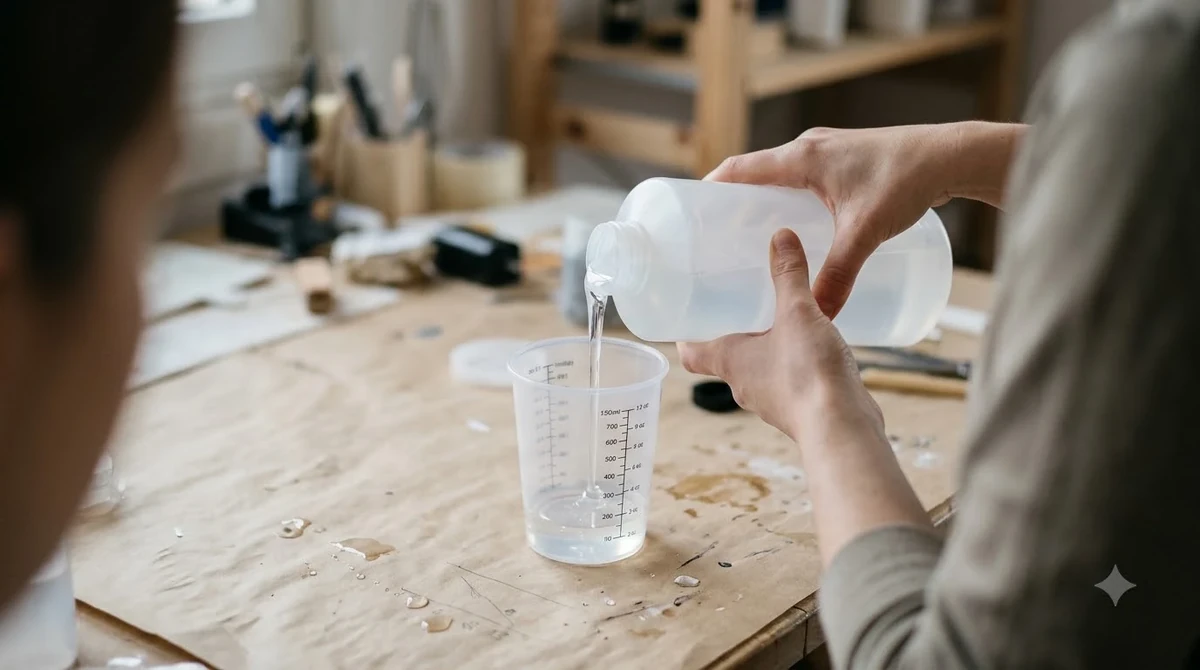
Some products use other ratios. WEST SYSTEM says to combine five parts 105 Resin with one part 205 or 206 hardener by weight or volume. It says to combine three parts 105 Resin with one part 207 or 209 hardener by volume. Always match the numbers to the exact hardener you bought, not to a similar product.
Measuring Epoxy by Weight or Volume
Weighing is the most precise option, and it is the method System Three says it uses. Volume measuring with graduated cups works well for many standard systems. Both methods work when you follow the maker’s ratio exactly.
How to measure epoxy by weight
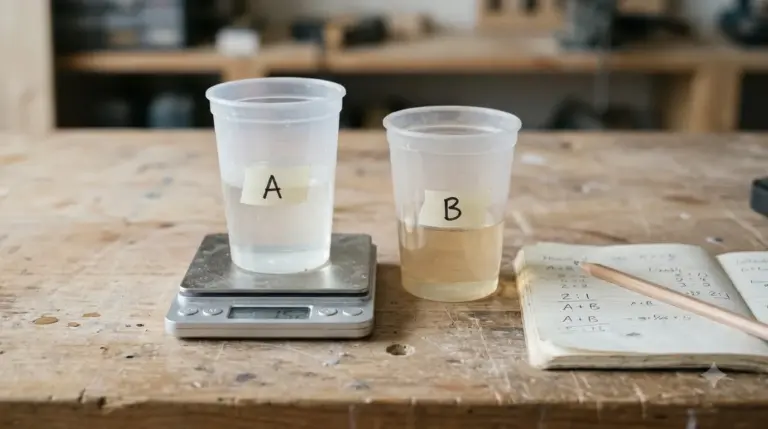
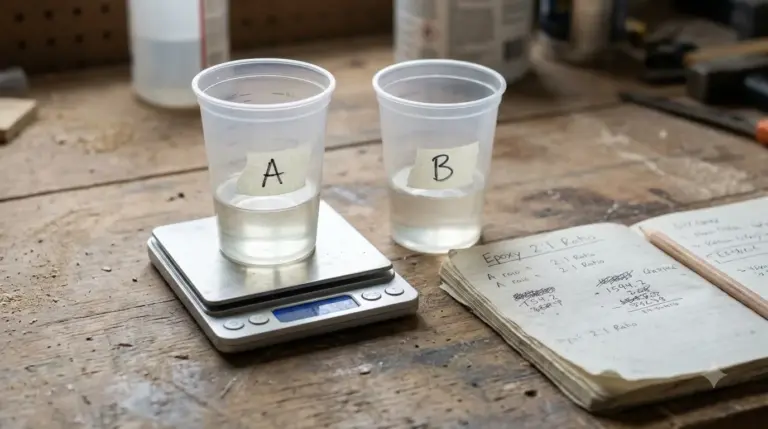
Weighing is the better choice for small batches and for products with fillers. Use a digital gram scale or a food scale set to grams. Follow the sequence in TotalBoat’s guide on measuring epoxy by weight and volume so the cup weight is not counted in the hardener.
- Set the cup on the scale and zero it. The cup weight should read as zero.
- Add the resin (Part A) until it reaches the required weight. Read the number carefully before you move on.
- Zero the scale again without removing the cup. This resets the reading so only the hardener is counted.
- Add the hardener (Part B) to the same cup. Stop when the reading matches the required weight from the data sheet.
Use the weight ratio from the data sheet, not the volume ratio. System Three warns that using the volume ratio when you measure by weight leads to errors.
How to measure epoxy by volume
Volume measuring uses graduated cups. Pick a cup that holds your full batch with room to spare. Find the marks that match your ratio on the side of the cup, and pour the resin to its mark first. Then pour the hardener until it reaches the matching mark in the second column.
System Three suggests pouring the same part first every time. Note how much resin is in the cup before adding hardener, then add hardener to the correct total. Doing it the same way each time reduces the common error of adding too much hardener. WEST SYSTEM’s calibrated pumps work on a simple rule: one full pump stroke of resin for one full stroke of hardener, with no partial strokes.
Check your cup before you trust it. System Three notes that some disposable paper cups have graduation lines that are placed too high or too low. Compare the marks to a scale when you can.
Mixing Thoroughly Without Trapping Air
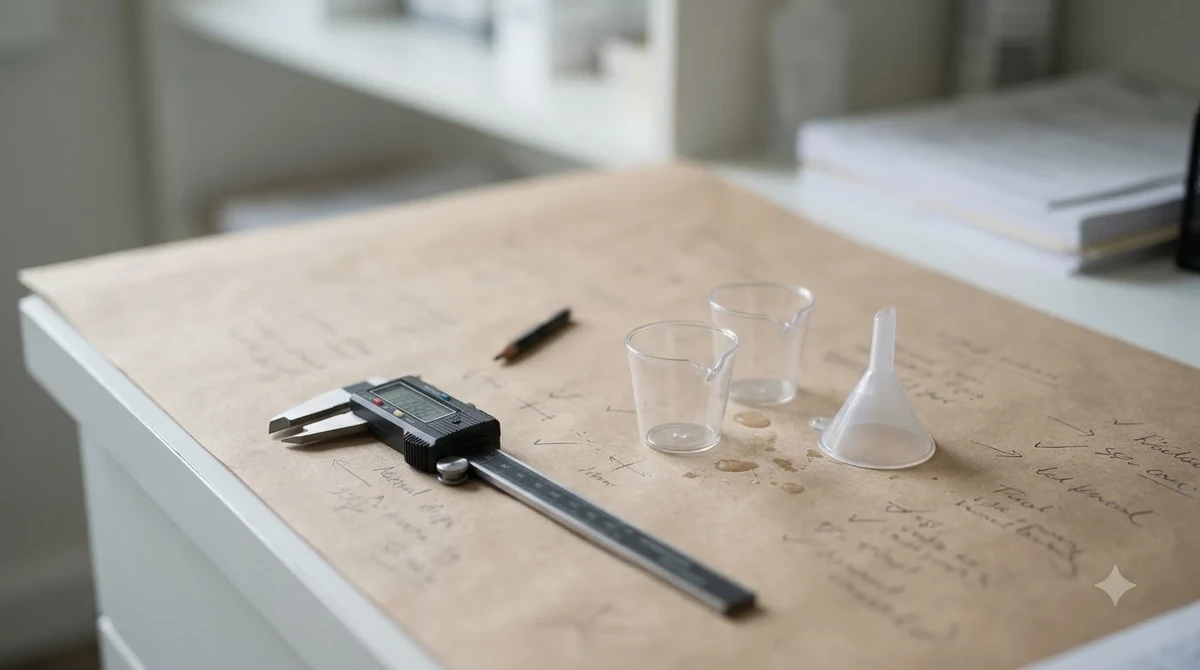
Measuring is only half the job. Mix the components completely, then scrape the container so no unmixed material stays on the walls or bottom. Mixing too hard can add air, so keep the motion steady.
WEST SYSTEM says to stir at least one minute, and longer in cooler temperatures. According to its dispensing and mixing guidance, the company also warns that several inches of mixed epoxy in a confined mass can generate enough heat to melt a plastic cup, so pour large batches into shallow containers. UltraClear recommends stirring for three to five minutes, depending on batch size. Scrape the sides, bottom and corners as you go. System Three suggests stirring until the mixture is no longer hazy, then using a two-container method. Pour into a second container, scrape the first one clean, and stir again.
Tip: Work in small batches when you can. System Three suggests making three 12-ounce batches rather than one 36-ounce batch, because large batches cure faster and have a shorter pot life.
Calculating How Much Epoxy You Need
Figure out the total volume you need before you measure a single part. Measure the length, width and depth of the area you will fill. Then compare that volume to the product’s recommended pour depth and batch size. Use the epoxy calculator to estimate the amount, then divide it into batches that match the ratio.
Pour depth matters. UltraClear says its bar and table top epoxy suits pours up to 1/4 inch per layer, in batches of 16 to 32 ounces. Its deep pour product is suited to pours up to 2 inches, with batches of 64 to 128 ounces and a 30-minute working time. WEST SYSTEM warns against casting layers thicker than 1/2 inch, and thinner if the layer is enclosed by foam or insulation.
| Product type named in sources | Pour depth from the source | Batch size from the source |
|---|---|---|
| UltraClear bar and table top (1:1 by volume) | Up to 1/4 inch per layer | 16 to 32 ounces |
| UltraClear deep pour (2:1 by volume) | Up to 2 inches | 64 to 128 ounces |
| WEST SYSTEM general casting guidance | Not thicker than 1/2 inch | Several ounces in small batches |
Plan a little extra for cup residue and small losses. Check the data sheet for the exact figures before you order, since numbers vary by product. For a broader look at project planning, see Calculators & Coverage, and for budgeting, the how much does epoxy cost page covers what to expect.
Common Measuring Mistakes and How to Fix Them
Most measuring errors come from guessing, changing methods, or skipping a check. Each mistake below has a simple fix. If a batch still stays soft after you correct your technique, scrape it off and start over.
- Eyeballing the amounts. Use a graduated cup or a scale every time. UltraClear warns that estimated ratios can leave tacky or soft spots.
- Mixing weight and volume. Use the weight ratio only when you weigh, and the volume ratio only when you measure by volume.
- Counting the cup weight. Zero the scale after the resin is added, as TotalBoat’s method shows.
- Changing the order. Pour the same part first each time, according to System Three.
- Stirring too little or too fast. Scrape the walls and bottom, and stir until the mix is clear and uniform.
If you suspect the measurement, run a gel time test. System Three suggests measuring three to six fluid ounces, or at least 50 grams, of mixed material in one container. Record the start time and temperature, then compare the gel time to the data sheet. If the gel time is close to the listed time, the problem was probably in measuring or mixing.
Frequently Asked Questions
How do I measure epoxy resin and hardener by weight?
Place a clean cup on a gram scale and zero it. Add the required weight of resin, then zero the scale again without removing the cup. Add the hardener to the same cup until it reaches the weight listed on the data sheet.
Can I measure epoxy by volume with graduated cups?
Yes, many systems are made for volume measuring. Pour the resin to the mark for your ratio, then add hardener to the matching mark. System Three suggests measuring in the same order every time to avoid mixing the wrong proportion.
Why is the weight ratio different from the volume ratio?
Resin and hardener have different densities. Because of that, a 1:1 volume ratio may be about 100:83 by weight. System Three gives a 2:1 volume ratio as roughly 100:43 by weight. Always use the ratio that matches how you measure.
Do I need metered pumps to measure epoxy accurately?
No. System Three says good technique and a scale or graduated cup work well for 1:1 and 2:1 volume products. Calibrated pumps are convenient, but they need periodic checks with a scale or cup. System Three no longer offers mechanical pumps.
Measure carefully, mix completely, and check the ratio before each batch. For the full method and the exact numbers for your product, read the manufacturer’s data sheet, then plan your batch with the epoxy calculator.
More in Calculators & Coverage
 How Much Deep Pour Epoxy Do I Need? Calculate Gallons and Kits From Your Mold SizeUpdated Nov 26, 2026
 MAS Epoxies Resin Calculator: How Much Epoxy Your Project NeedsUpdated Nov 26, 2026
 How Much Does UV Resin Cost Per Ounce and Per Project?Updated Nov 26, 2026
 Cost of a Gallon of Epoxy Resin and How Far One Gallon GoesUpdated Nov 26, 2026
 How Much Does Epoxy Cost? Gallon Prices and Project BudgetsUpdated Nov 26, 2026
 Epoxy Calculator: How Much Resin Your Project Really NeedsUpdated Nov 26, 2026