

We may earn a commission when you buy through links on this page, at no extra cost to you. Learn more.
How long for deep pour epoxy to cure depends on the product, but most manufacturer sheets list demold times from about 24 hours to 72 hours and full cure from 3 days to 30 days. Your pour depth, the mass of mixed resin and the room temperature all shift those windows. Treat the published numbers as the starting point, not a guarantee.
This guide explains how long deep pour casting resin takes to cure at each stage, why label times can run shorter or longer in your shop, and what to watch for before you move, sand or use a piece. If you are new to the chemistry, the Resin Basics & Q&A section covers the terms used here.
What Deep Pour Epoxy Cure Time Actually Means
Cure time is not one moment. It is a series of stages, from the point the resin starts to thicken, through the point you can remove it from a mold, to the point the casting reaches full hardness. Each stage has its own number on the manufacturer’s sheet.
Working time, or pot life, is the window you have to mix and pour before the resin starts to set. Gel time comes later, when the mix turns from liquid to a jelly-like state. Demold time is when the casting is firm enough to release from its form. Full cure is when the polymer reaches maximum hardness. The gap between demold and full cure can be several days or several weeks.
Many buyers read the demold number and assume the piece is ready for use. The manufacturers in this guide describe those two points separately for a reason. A casting can feel firm to the touch while its internal chemistry is still finishing.
Typical Cure Timelines by Stage
Each product in the sources uses a different chemistry, mix ratio and temperature target, so the timelines below should be read product by product. Compare the columns to see how wide the range is, then check the data sheet for the exact product you own.
| Product (as named in its source) | Mix ratio by volume | Gel or working time | Demold time | Full cure |
|---|---|---|---|---|
| TotalBoat ThickSet | 1:1 | Pot life 10 min, gel 70 min at 77°F | 24 hours | 3-5 days |
| TotalBoat Fathom | 2:1 | 4-6 hours working time | 48-72+ hours | 5-10 days (source notes 5-7 days once all layers are done) |
| MAS Deep Pour | 3:1 | Extended gel time for less exotherm | Not listed on the product page | Cures within 24-36 hours at 70°F (per the product page) |
| Craft Resin Deep Pour | 2:1 | About 1 hour | From 48 hours | 48-72 hours |
| Superclear Liquid Glass Deep Pour | 2:1 | Gel 10-12 hours | 48-72 hours | 30 days |
| Superclear 24 Hour Liquid Glass | 2:1 | Gel 18-20 hours | 24-36 hours | 30 days |
The table shows two patterns. Some products list a single number that could mean either a set point or a full cure, so read the sheet closely before planning a schedule. Others separate demold from full cure, which is the more useful split for planning.
If you are comparing products for a river table, the deep pour vs table top epoxy comparison explains why thick-pour systems are built with slower reactions.
How Pour Depth and Temperature Change Cure Time
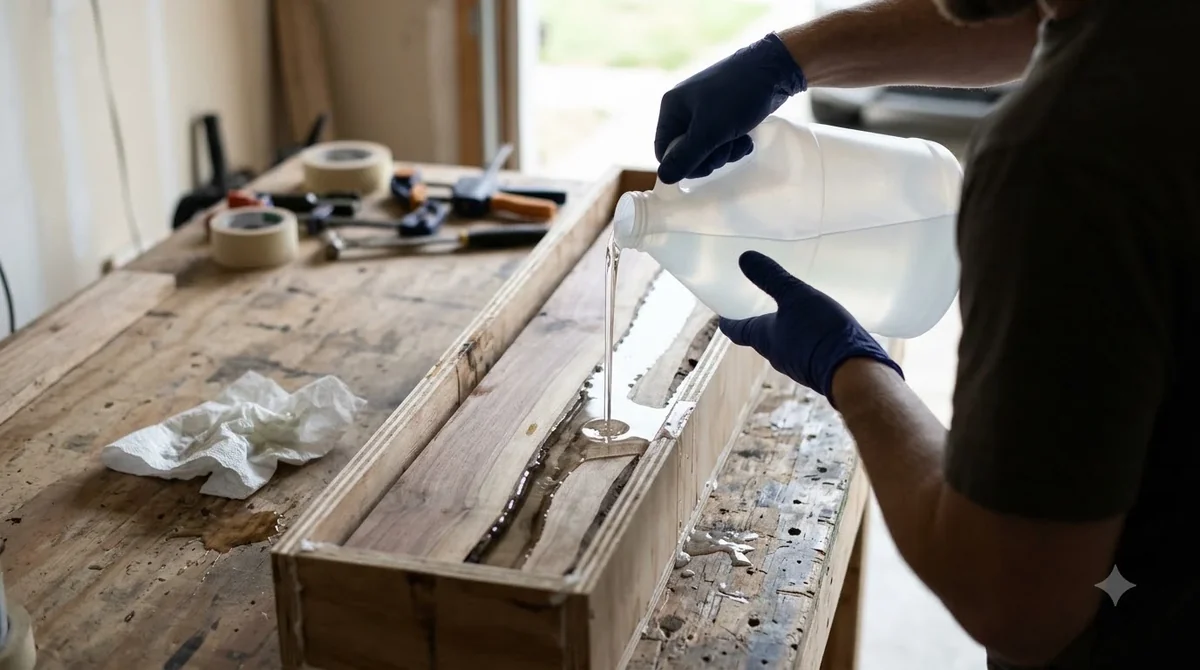
Pour depth and room temperature do more to change cure time than almost anything else you control. The manufacturers say the same thing in different words: mass produces heat, and heat speeds the reaction. Thick, warm pours can cure faster in some places and cause problems in others.
Maximum depth per layer varies by product. TotalBoat ThickSet lists 1/2 inch for river and slab pours and up to 2 inches for smaller castings using less than 10 ounces of epoxy. TotalBoat Fathom lists up to 3 inches for larger castings. MAS says 0.5 inch for a full 1.3-gallon kit and 1 inch for a half kit. Superclear lists 2 to 4 inches for its Liquid Glass Deep Pour and 1 inch for its 24 Hour product. Craft Resin suggests 5 cm layers for large pours.
Temperature matters just as much. ThickSet asks for an application range of 65°F to 75°F and says the ambient temperature must be between 65°F and 80°F for a full cure. Fathom lists 60°F to 80°F and advises against use above 80°F. MAS recommends a constant 60°F to 75°F and warns against working above 75°F. Craft Resin gives a minimum working temperature of 18°C and an ideal range of 21°C to 27°C. Superclear recommends 70°F to 84°F and says cure slows dramatically below 65°F and can become uneven above 85°F.
In practice, a cold shop stretches every timeline, and a hot shop can speed the reaction too much and cause cloudiness or cracks. Keep the room stable through the early cure window. Avoid swings between a warm afternoon and a cold night.
Demold Time vs Full Cure Time
Demold time tells you when the casting can leave its mold. Full cure tells you when the resin has reached its final hardness and chemical stability. Those are different jobs, and a river table or large casting should be planned around the second number.
Superclear makes this point clearly: its Liquid Glass Deep Pour can be demolded at 48 to 72 hours, yet it reaches full cure and maximum hardness at 30 days. The same source says a casting that is hard to the touch within 24 hours is not necessarily fully cured. Sanding, surface impressions and long-term resistance all depend on the later stage.
Fathom shows a similar gap. Its demold window is 48 to 72 hours or more, but the full cure is listed as 5 to 10 days depending on the mass of mixed epoxy. ThickSet is faster, with a 24-hour demold and a 3 to 5 day full cure. A useful habit is to write both dates on your project calendar, then treat the second one as the date you can load, polish or deliver the piece.
If you are unsure whether a piece can take weight or sit on a counter, check the manufacturer’s sheet for the product you used. ThickSet says not to place items hotter than 122°F on the cured surface. Fathom says not to place items hotter than 125°F. These are heat limits, not load limits, so a separate check is needed for anything structural. To understand the system behind this, read Epoxy Full Cure Time.
Signs Your Deep Pour Is Not Curing Properly
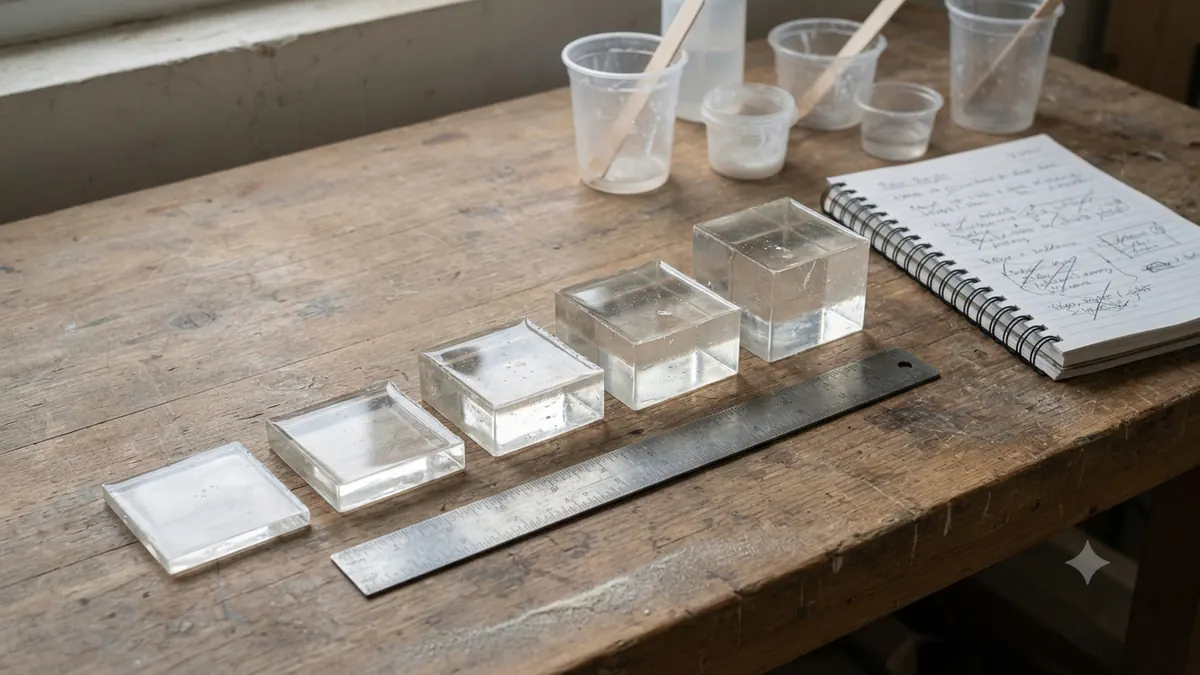
A pour that stays tacky, soft or cloudy after the expected window usually points to one of a few causes. The most common in the sources are an off-ratio mix, under-mixing and low temperature. Overheating is the main cause of yellowing and cracks in thick masses.
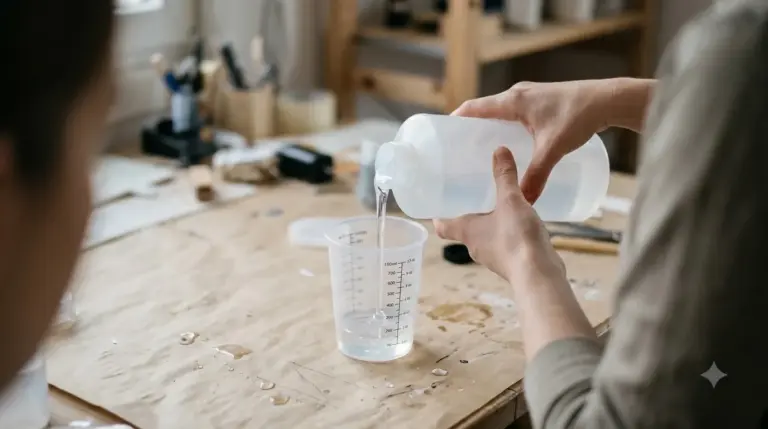
Tacky or soft spots after several days are often a mixing issue. Craft Resin notes that off-ratio or under-mixed resin can show up as tackiness, soft spots or an incomplete cure. Superclear says a ratio error of even about 10 percent can leave unreacted material that never fully cures. Measure by volume with graduated cups, and do not eyeball the batch.
Cloudiness can come from moisture, temperature shock or under-mixing. Superclear recommends stirring for 3 to 5 minutes, scraping the sides and bottom, then transferring to a clean container and mixing for about 2 more minutes. That second container catches resin clinging to the first.
Cracking or yellowing suggests the exotherm ran too hot. This is more likely with a large mass, a high room temperature or a pour deeper than the product allows. MAS warns that mixed epoxy generates heat and that pouring too much into one area can cause shrinking, yellowing or cracking.
| Symptom | Likely cause named in the sources | What to check |
|---|---|---|
| Tacky or soft surface well past the demold window | Off-ratio mix, under-mixing or low temperature | Re-measure by volume, confirm the room temperature, and review the mixing time |
| Hazy or cloudy casting | Moisture, temperature shock or under-mixing | Keep materials dry, match temperatures and use the double-container method |
| Yellowing, cracks or shrinkage | Exotherm from too much mass or heat | Check pour depth against the product sheet and keep the room cool |
| Surface marks after light handling | Piece handled before the manufacturer’s window | Wait for the full-cure date before sanding or loading |
If the surface still feels tacky after the full-cure window on the sheet, contact the manufacturer with the batch details. Do not keep adding coats on top of an uncured layer.
Speeding Up or Slowing Down the Cure Safely
You can shift the timeline within the manufacturer’s limits, but you cannot override the chemistry. The safest approach is to hold the room inside the recommended temperature range and let the product run its normal course. Speeding the cure with extra heat is where most avoidable problems start.
To slow an overheating pour, MAS suggests keeping the work area cool, and it notes that a fan can help reduce the risk of overheating. Splitting a large casting into separate pours is another option. Superclear suggests considering two 2-inch pours instead of one 4-inch pour in a warm shop. Fathom and ThickSet both say to wait for the previous layer to cool and firm before adding the next one.
Step pours need timing. Fathom’s sheet says the safest minimum wait between layers is 36 hours, and the previous layer should be below 85°F before you pour again. Superclear advises pouring the next layer after about 24 to 36 hours, while the first layer is still gel-but-tacky, so the two bond without surface prep. ThickSet’s guidance is to pour the next layer when the previous one can be indented lightly with a fingernail. If the first layer has fully hardened, sand it before adding more, using 80 to 120 grit as Superclear suggests.
Speeding the cure with a heat gun or space heater is not the same as warming the room. Surface bubbles can be broken with a heat gun, as Superclear describes, but that is a brief pass over the surface, not a way to shorten the full cure. If you raise the room temperature, do it steadily before you mix, and keep it inside the product range.
To slow a fast set in a warm room, cool the mixing area, mix smaller batches and pour in the recommended layers. Do not place uncured resin near a heat source.
Safety Gear and Ventilation During Curing
Uncured epoxy and its hardener are reactive, so wear gloves, eye protection and clothing that covers your skin. The TotalBoat sheets recommend working in a well-ventilated area and wearing gloves, eye protection, face protection and clothing protection. Craft Resin points to nitrile gloves, safety glasses and long sleeves for mixing and pouring.
MAS warns that mixed epoxy may fume and smoke during an exothermic reaction, so ventilate the room and avoid leaning over a large mixed batch. Keep the mixed volume to what you will pour right away. Read the safety data sheet for the exact resin and hardener you bought, and follow its handling and disposal instructions. Keep children and pets out of the curing area.
Frequently Asked Questions
How long does deep pour epoxy take to cure fully?
Full cure depends on the product. ThickSet lists 3 to 5 days, Fathom lists 5 to 10 days, and Superclear lists 30 days for both of its deep pour products. Check the data sheet for your exact resin.
How long before I can demold deep pour epoxy?
Demold windows in the sources range from about 24 hours to 72 hours or more. MAS does not list a demold time on its product page, so you should confirm it with the manufacturer. Do not force a casting out early.
How long should I wait between layers?
Fathom’s sheet calls 36 hours the safest minimum between layers, with the previous layer below 85°F. Superclear suggests 24 to 36 hours. Test the surface before you pour, and sand to 80 to 120 grit if it has fully hardened.
Can I use a deep pour epoxy table before it is fully cured?
Demold and full cure are separate stages, and the sources give no load or walking guidance for uncured pieces. Wait for the full-cure date on your product sheet before using the surface. Keep hot items off the cured surface, since ThickSet and Fathom set limits of 122°F and 125°F.
Plan around the full-cure date, not the demold date, and keep the room in the recommended temperature range for the whole cure. For a wider look at cure timing across resin types, read the how long does epoxy take to cure guide. For the product data behind these numbers, see the TotalBoat Fathom deep pour product page, which lists its demold and full-cure windows.
More in Resin Basics & Q&A
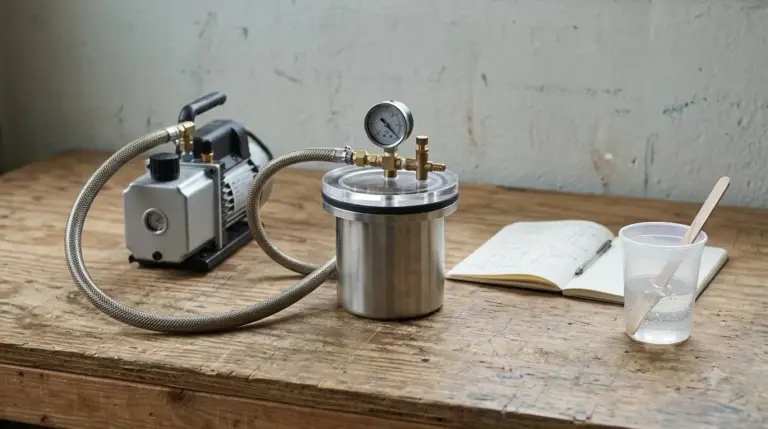 What Is Vacuum Degassing for Epoxy Resin and How It Removes Trapped BubblesUpdated Nov 26, 2026
 Epoxy Full Cure Time: How Long Before Your Project Is Ready to UseUpdated Nov 26, 2026
 Envirotex Lite Pour On Instructions for a Glossy, Bubble-Free FinishUpdated Nov 26, 2026
 Deep Pour vs Table Top Epoxy: Which Fits Your Project Depth and Cure TimeUpdated Nov 26, 2026
 High Temperature Epoxy for Metal: How to Pick One That Holds Up to HeatUpdated Nov 26, 2026
 Amazing Clear Cast Resin Instructions: Mix, Pour and Cure Without BubblesUpdated Nov 26, 2026