

We may earn a commission when you buy through links on this page, at no extra cost to you. Learn more.
An epoxy calculator multiplies your pour’s length, width and depth to find the volume, then converts that volume into fluid ounces and gallons. For a rectangle, you multiply length by width by thickness in inches, then divide cubic inches by 1.805 to get US fluid ounces. TotalBoat advises adding 5-10% extra for most applications, and Craft Resin suggests a 10% allowance as a good starting point. Thickness is the figure that changes the result most.
This guide shows you how to run the numbers by hand or with a calculator tool, so you can order the right amount of resin for a coating, a tabletop or a deep pour. You will also see coverage rates from manufacturer sources, worked examples and a short list of mistakes that throw off the math.
How an Epoxy Calculator Works
An epoxy calculator turns the shape of your surface into a volume. Once you know the volume, it converts that figure into units you can use when buying kits. Most tools follow the same core steps, whatever brand publishes them.
For flat surfaces, the formula is length times width times thickness. For round projects, the formula is pi times the radius squared times thickness. Resiners gives the round formula as pi times (diameter divided by 2) squared times thickness, and it uses the same thickness unit as your measurements.
After you have cubic inches, the conversion is simple. TotalBoat says to divide cubic inches by 1.805 to get US fluid ounces, then divide ounces by 128 to get gallons. Resiners uses a slightly different factor of 0.554113 when converting cubic inches to fluid ounces, so check which tool you use and keep your units consistent.
Measuring Surface Area and Pour Depth
Accurate measurements matter more than any formula. Measure length and width in inches, and convert fractions to decimals before you multiply. A quarter inch is 0.25, and an eighth inch is 0.125.
Depth is the number most people get wrong. Superclear warns that the depth you enter should be the depth you actually intend to pour, not the product’s maximum. Its countertop epoxy can be poured up to a quarter inch per pour, but it self-levels at roughly 1/32 to 1/16 of an inch. Entering a quarter inch when the coat will settle thinner can push your estimate to about four times the resin you need.
For irregular shapes, break the surface into rectangles and circles, calculate each one, and add the results. BestBartopEpoxy suggests measuring a river channel at several evenly spaced points and averaging the width, then multiplying by the length and full depth.
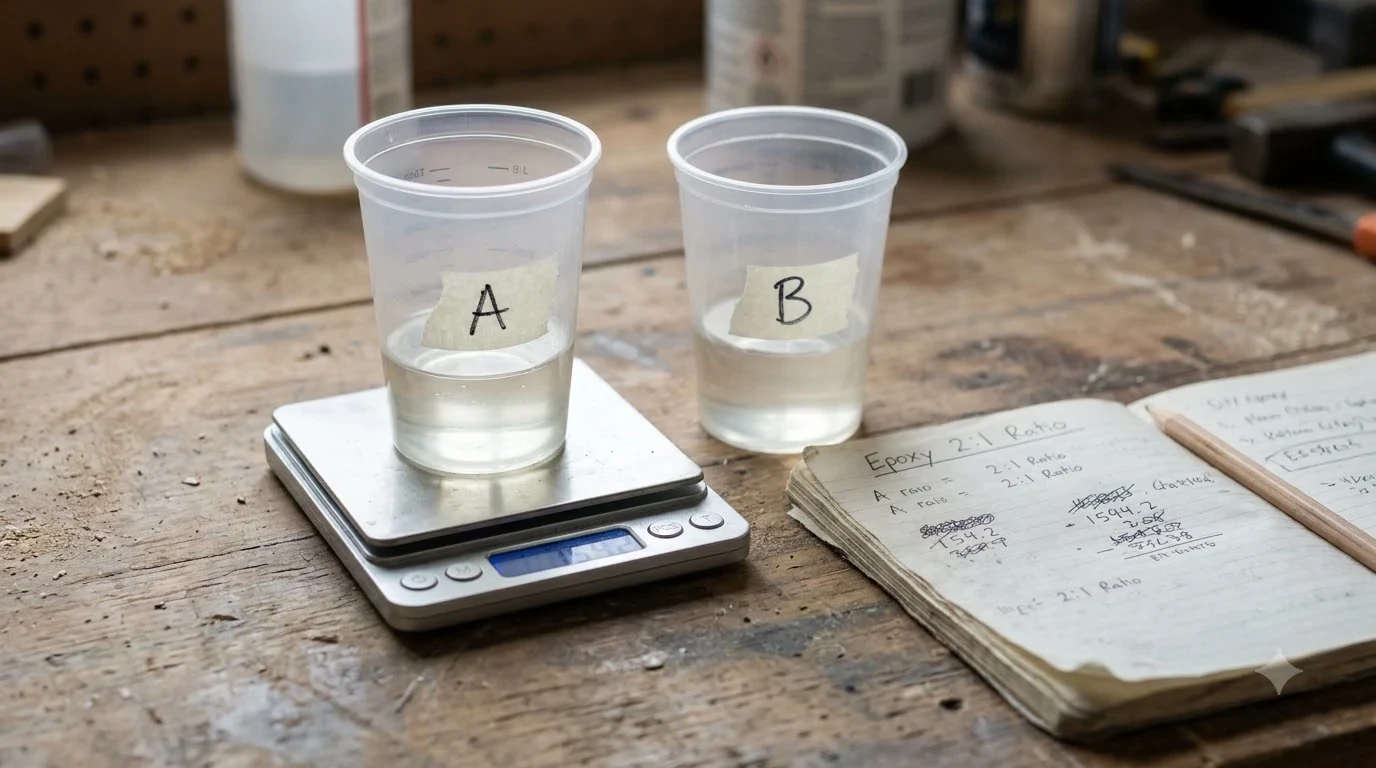
Tip: Write down every measurement and conversion on paper before you open the calculator. A single transposed number is the most common source of a short order.
Resin Calculator Math for Tabletops and Rounds
A worked example makes the process concrete. Craft Resin uses a tabletop that measures 24 by 18 inches with a 1/8 inch coating. Multiplying 24 by 18 by 0.125 gives 54 cubic inches, which is the volume of mixed epoxy the surface needs.
Dividing 54 by 1.805 gives roughly 29.9 US fluid ounces. Divided by 128, that comes to about 0.23 gallon. This is the base amount before you add any waste allowance, and it is the figure to compare against kit sizes on the product page.
Round projects follow the same path. Craft Resin’s example is a 12 inch diameter tray at 1/4 inch depth. The radius is 6 inches, and the calculation gives 28.26 cubic inches. Use the same conversion steps to turn that into ounces or gallons for ordering.
| Project shape | Formula | Example from source |
|---|---|---|
| Rectangle or tabletop | Length x width x thickness | 24 x 18 x 0.125 = 54 cubic inches |
| Round tray or mold | Pi x radius squared x thickness | 12 inch diameter, 1/4 inch deep = 28.26 cubic inches |
| Fluid ounces | Cubic inches divided by 1.805 | TotalBoat conversion |
| Gallons | Fluid ounces divided by 128 | TotalBoat conversion |
How Much Epoxy Per Square Foot
Coverage per square foot depends almost entirely on thickness. Thin coats cover a lot of area, while deeper pours cover much less with the same quantity of resin. Thinking in terms of square feet per gallon makes it easier to plan a coat.
TotalBoat states that most common tabletop and bar top epoxies provide about 12 square feet per mixed gallon at 1/8 inch thickness. Working backward, a gallon spread over 12 square feet at that depth is what the manufacturer’s figure describes. Your surface might need more or less depending on the product and how it self-levels. For a closer look at the seal coat and flood coat steps behind those numbers, the TotalBoat epoxy coverage calculator page explains how the manufacturer approaches thickness.
Resiners adds a metric check. It says 1 square meter at 1 mm thickness needs about 1 liter, and it notes that 1000 square feet is about 92.9 square meters. Those figures help if you are comparing products sold in metric units.
How Much Does a Gallon of Epoxy Cover
A gallon covers a different area at each depth, so the right answer depends on the job. Coating work, such as a bar top, uses shallow depths. Casting and river tables use much deeper layers, which quickly consume a kit.
BestBartopEpoxy’s coverage reference for a 1.5 gallon UltraClear Deep Pour kit lists 10 square feet at 1/4 inch deep, 5 square feet at 1/2 inch, 2.5 square feet at 1 inch and 1.25 square feet at 2 inches total. The table is a reference only, and the company says pour depth per layer must follow the product instructions.
| Pour depth | Coverage for a 1.5 gallon deep pour kit |
|---|---|
| 1/4 inch | 10 square feet |
| 1/2 inch | 5 square feet |
| 1 inch | 2.5 square feet |
| 2 inches total | 1.25 square feet |
Coverage numbers are only as good as the depth you enter. Read the product’s data sheet for the depth it recommends per layer before you commit to a kit. Coverage tables also do not include waste, so the calculated amount is always a floor, not a target.
How Much Resin Do I Need for My Project
To estimate resin for a specific project, start with the shape and depth, convert to gallons, then add waste. This step-by-step order keeps the math honest and makes it easy to check against a supplier’s kit sizes.
Follow these steps for a typical flat project:
- Measure the surface. Record length and width in inches.
- Choose the depth. Use the depth you plan to pour, not the product maximum.
- Calculate volume. Multiply length, width and depth in cubic inches.
- Convert to ounces. Divide cubic inches by 1.805.
- Convert to gallons. Divide fluid ounces by 128.
- Add waste. Apply 5-10% or more, depending on the source you follow.
- Round up to kits. Compare the total with the kit sizes on the product page.
Superclear suggests that if you are between kit sizes, rounding up to the next size is usually the safer choice. It is far more expensive to run short mid-pour than to keep a small amount left over.
Adding Waste, Overflow and Mixing Losses
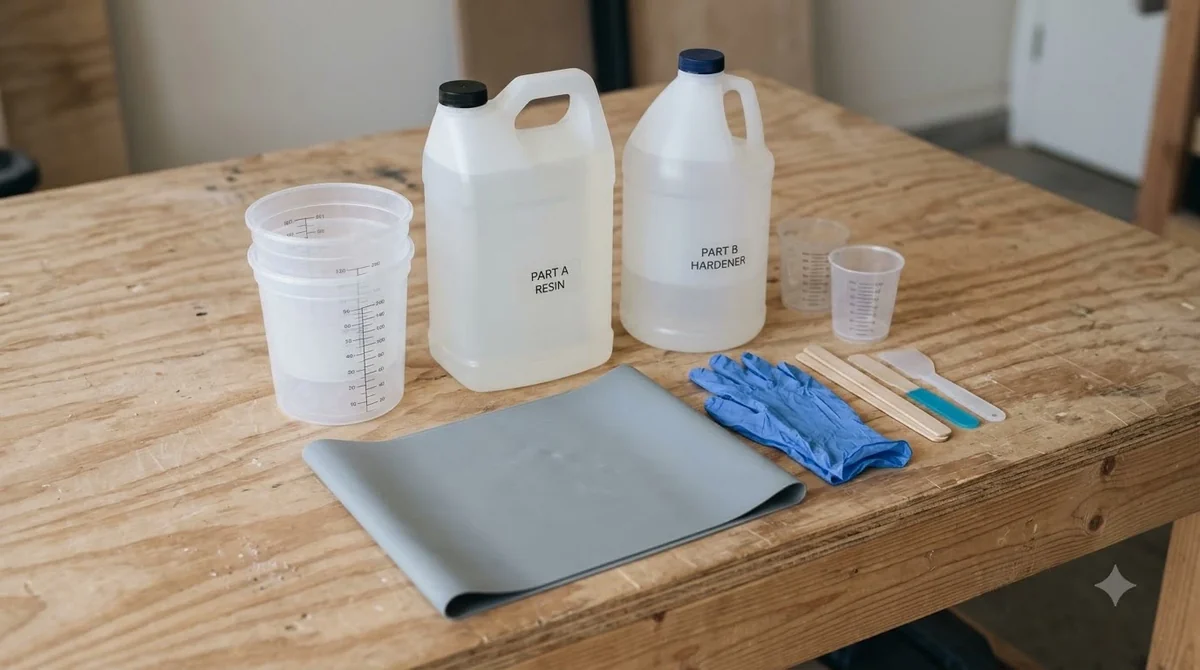
Every epoxy calculator gives a geometric answer, and real projects lose material. Some resin stays on the stir stick, the bottom corners of the mixing cup and the surface edges. Porous wood can absorb resin as well.
TotalBoat advises adding 5-10% extra for most applications to cover wasted epoxy on the stir stick, cup bottom corners and drips. Craft Resin recommends 5-15% and calls 10% a good starting point for many projects. Use the higher end when you are working with wood or live edge pieces.
BestBartopEpoxy notes that its geometric volume does not account for material left in mixing cups, seepage or unmeasured gaps. Rounding up to whole kits gives a variable amount of extra material rather than a fixed allowance. Treat that rounding as a bonus, not as a replacement for a planned waste percentage.
Tip: Mix in a clean plastic, metal or unwaxed paper cup. Superclear and TotalBoat both caution against foam or glass cups, because epoxy can dissolve some foams and glass cups are not recommended for exothermic heat.
Deep Pour and River Table Quantities
Deep pour projects need a different calculation because the depth changes the resin volume quickly, and the mix ratio may be by volume or by weight. Check the product label before you measure anything.
UltraClear Deep Pour Epoxy mixes 2:1 by volume, and a 1.5 gallon kit contains 1 gallon of resin and half a gallon of hardener. Craft Resin’s Deep Pour Epoxy also mixes at 2:1 and can be poured up to 2 inches in one layer. Superclear’s Liquid Glass Deep Pour is also 2:1 by volume, and it pours 2 to 4 inches in a single application depending on temperature and total mass.
Superclear lists weight ratios that differ by product. Its Liquid Glass Deep Pour is 100A to 44B, its 24 Hour Deep Pour is 100A to 43B, and its Table Top Epoxy is 100A to 83B. Weight ratios are not the same as volume ratios, so do not assume one carries over to the other.
| Product named in source | Mix by volume | Mix by weight (A to B) |
|---|---|---|
| UltraClear Deep Pour Epoxy | 2:1 | Not listed in source |
| Craft Resin Deep Pour Epoxy | 2:1 | Not listed in source |
| Superclear Liquid Glass Deep Pour | 2:1 | 100:44 |
| Superclear Table Top Epoxy | 1:1 | 100:83 |
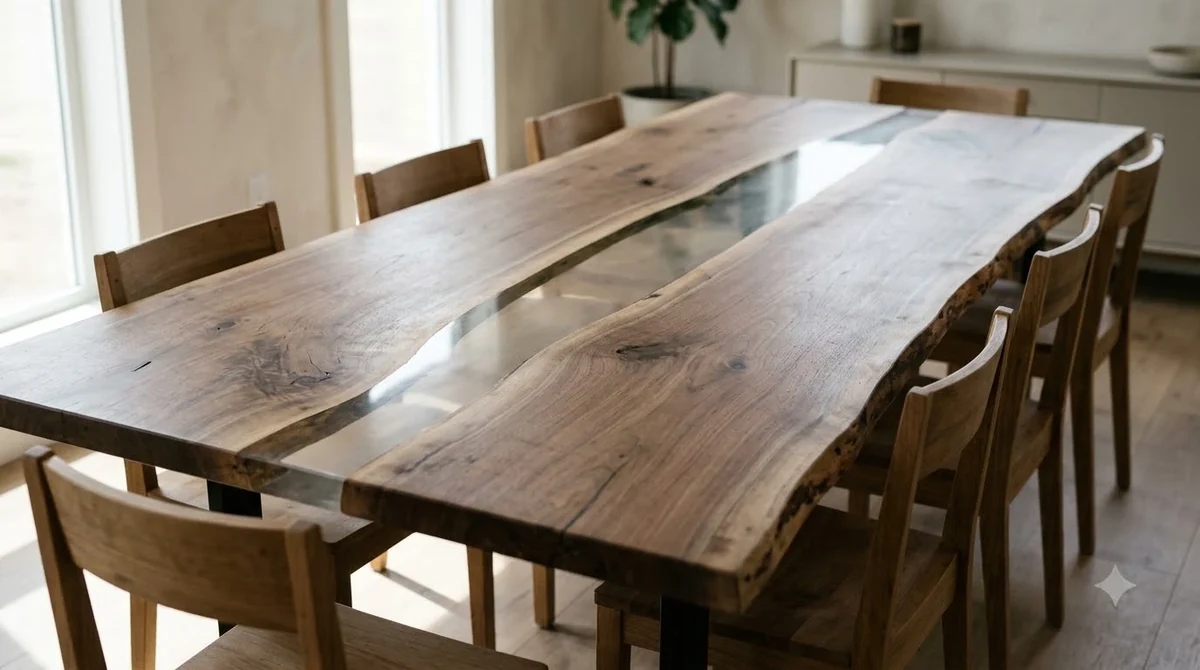
For a river table, measure only the cavity between the slabs. BestBartopEpoxy notes that solid objects displace epoxy, so a cavity filled with objects may need less resin than an empty one of the same size. Seal porous wood and live edges first, because they can release air into the resin during the deep pour.
Common Mistakes and Troubleshooting Quantities
Most quantity problems come from a few predictable errors. Fixing them before you order saves material and avoids a half-cured surface.
The first mistake is using the maximum pour depth instead of the planned depth. The second is mixing up volume and weight ratios. The third is forgetting that a seal coat adds resin before the flood coat. TotalBoat says a seal coat should only be needed for wood or other porous materials, and it helps prevent air bubbles from escaping the substrate.
If you run short, stop and check your math before ordering more. Mixing a second batch that does not match the first can leave visible differences in color or cure. The safest habit is to calculate with a waste allowance from the start.
Safety: Wear nitrile gloves, work in a well-ventilated space and read the product’s safety data sheet before mixing. Follow the manufacturer’s directions for handling and disposal.
Frequently Asked Questions
How do I calculate how much epoxy resin I need for a tabletop?
Multiply the tabletop’s length and width by the coating thickness in inches to get cubic inches. Divide by 1.805 for fluid ounces, then divide by 128 for gallons. Craft Resin’s example of a 24 by 18 inch top at 1/8 inch gives 54 cubic inches before waste.
How many fluid ounces are in a cubic inch for epoxy calculations?
TotalBoat says to divide cubic inches by 1.805 to get US fluid ounces, which means one cubic inch is about 0.554 fluid ounce. Resiners uses the factor 0.554113 for the same conversion. Use one method consistently throughout your calculation.
How much extra epoxy should I buy for waste?
TotalBoat recommends 5-10% extra for most applications, while Craft Resin suggests 5-15% and calls 10% a good starting point. Porous wood and live edge pieces may need the higher end. Round up to the next kit size if you are between sizes.
How deep can I pour epoxy in one layer?
It depends on the product. UltraClear Deep Pour Epoxy can be poured up to 1 inch per layer with 12 hours between layers, and Craft Resin Deep Pour Epoxy can go up to 2 inches. Always confirm the limit in the product instructions before you pour.
An epoxy calculator is a planning tool, and your final quantity depends on your surface, depth and waste habits. Start with the volume math, add a planned waste allowance, then compare the total with kit sizes on the product page. For more coverage examples, see the Calculators & Coverage hub, and check the how much does epoxy cost page once your quantity is set.
More in Calculators & Coverage
 How Much Deep Pour Epoxy Do I Need? Calculate Gallons and Kits From Your Mold SizeUpdated Nov 26, 2026
 How to Measure Epoxy Resin and Hardener by Weight or VolumeUpdated Nov 26, 2026
 MAS Epoxies Resin Calculator: How Much Epoxy Your Project NeedsUpdated Nov 26, 2026
 How Much Does UV Resin Cost Per Ounce and Per Project?Updated Nov 26, 2026
 Cost of a Gallon of Epoxy Resin and How Far One Gallon GoesUpdated Nov 26, 2026
 How Much Does Epoxy Cost? Gallon Prices and Project BudgetsUpdated Nov 26, 2026