

We may earn a commission when you buy through links on this page, at no extra cost to you. Learn more.
Learning how to mix epoxy resin starts with measuring resin and hardener at the exact ratio printed on your product label, then stirring while scraping the sides and bottom of the container. Many table top and art epoxies use a 1:1 ratio by volume, while some deep pour and marine products use 2:1 or 3:1. Most manufacturers ask you to stir for several minutes and to keep the workspace near 70°F to 80°F. Measurement errors and short mixing are the two most common causes of soft or sticky results.
Mixing is the step that decides whether your project cures hard and clear. The process is simple, but it depends on accurate measuring and patient stirring. This guide walks through the ratio, the tools, the timing, and what goes wrong when the mix is off.
Epoxy Mixing Ratio Explained
The mix ratio is the relationship between resin (Part A) and hardener (Part B) that your product was formulated to use. Always use the ratio on your own product’s instructions, because ratios differ between products.
Many table top and art epoxies are measured 1:1 by volume. UltraClear says its Table Top Epoxy uses a 1:1 ratio and its Deep Pour Epoxy uses 2:1, and it recommends measuring by volume rather than weight for those products. Marine and structural epoxies may use 2:1, 3:1, or other ratios.
Volume and weight are not interchangeable. Resin and hardener have different densities, so a 1:1 ratio by volume does not equal 1:1 by weight. If your manufacturer gives a weight ratio, use a scale and follow that number. Resiners gives an example of 100 grams of resin to 50 grams of hardener for a 2:1 weight ratio. If you are unsure whether your product is meant for volume or weight, check the label before you pour anything into the cup.
If you are deciding between epoxy and other coatings, the epoxy vs polyurethane comparison explains how their mixing and curing differ.
What You Need Before You Mix Epoxy
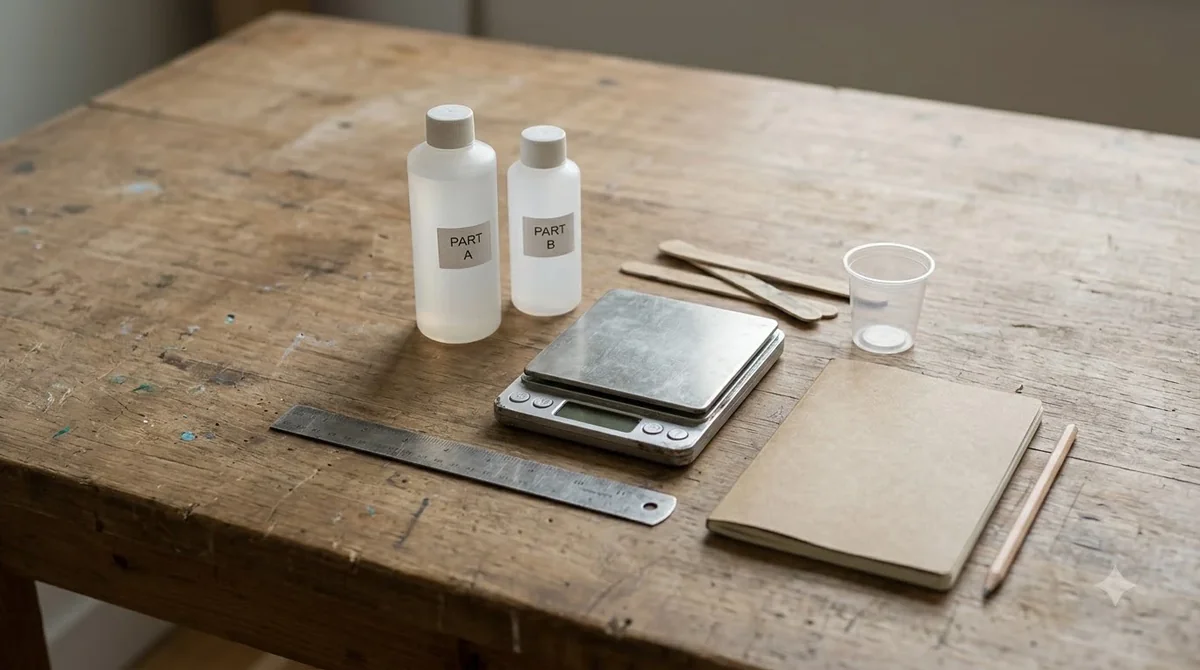
Gather every tool before you open the bottles, because the working time starts once the two parts meet. Clean containers and a clear work area matter as much as the epoxy itself.
Use these basics for most small and medium batches:
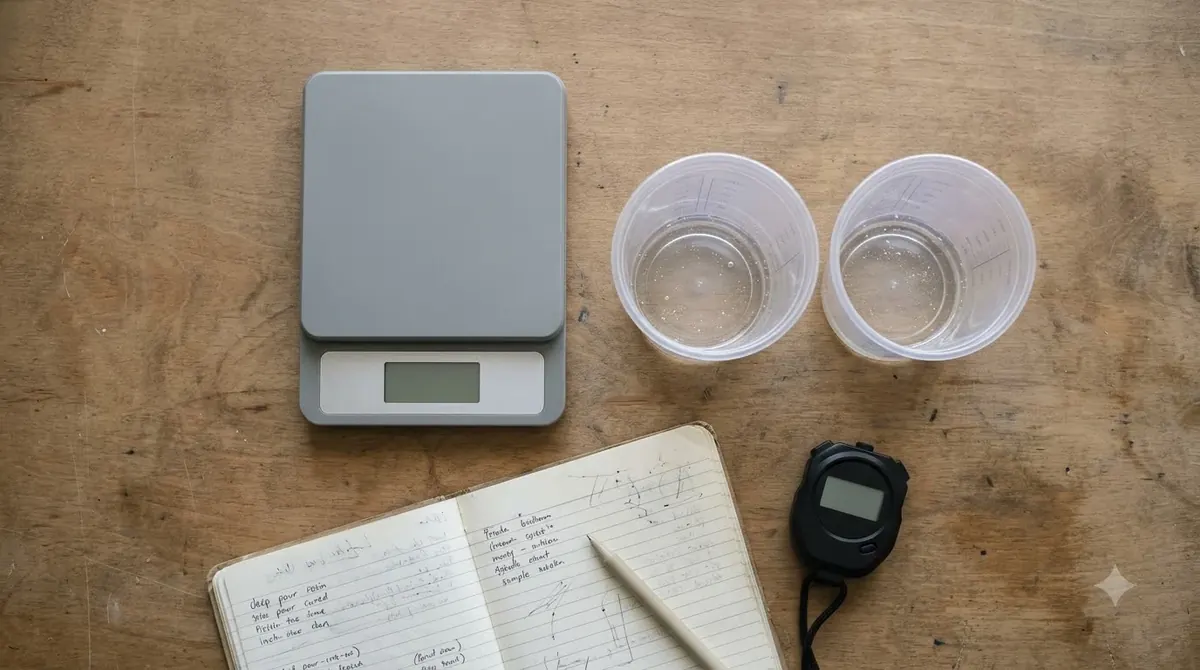
- Graduated mixing cups with clear volume lines
- Two clean cups, one for mixing and one for the transfer
- Stir sticks, with flat edges for scraping
- Nitrile gloves, eye protection, and plastic sheeting or a silicone mat
- A heat gun or torch for bubbles after pouring, if your project needs one
| Item | Why it matters |
|---|---|
| Graduated cups | Lets you measure each part by volume with clear lines |
| Second clean cup | Separates fully blended epoxy from unmixed material on the first cup’s walls |
| Polypropylene or HDPE containers | Mas Epoxies says polystyrene cups can melt at low temperatures |
| Thermometer | Helps you confirm the room is near the range your product lists |
Safety: Wear nitrile gloves and eye protection, and work in a ventilated space. UltraClear recommends an N95 or KN95 respirator. Read the safety data sheet (SDS) for your specific product.
Step-by-Step: How to Mix Epoxy Resin
The steps below follow the common two-cup method described by several manufacturers. Adjust times to match your product’s instructions.
Work through these steps in order:
- Set up your space. Cover the surface, confirm it is level, and keep the room near 70°F to 80°F.
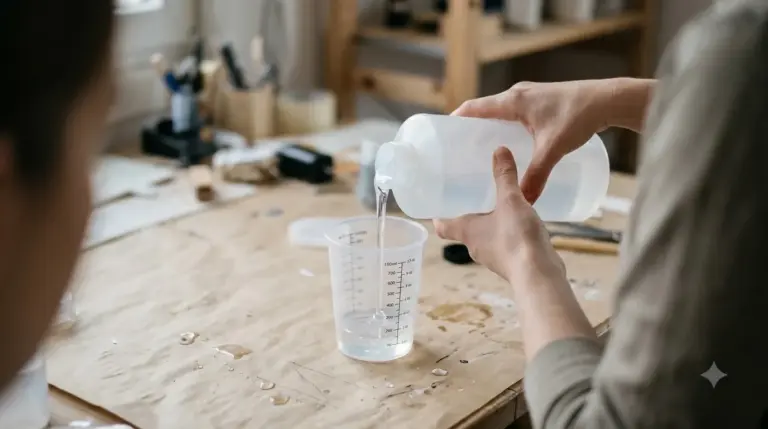
- Measure the resin. Pour the exact volume of Part A into a clean graduated cup.
- Measure the hardener. Add Part B at the ratio on the label. Check the line at eye level.
- Stir the first cup. Stir slowly and scrape the sides and bottom until the mix is uniform.
- Transfer. Pour the mix into a second clean cup, leaving the unmixed film behind.
- Stir the second cup. Scrape again until streaks disappear and the color is even.
- Rest briefly if needed. Mas Epoxies suggests letting the mix sit 1 to 2 minutes so air can rise.
- Pour right away. Start applying before the working time ends.
TotalBoat’s beginner guide describes a two-cup method of mixing 3 to 5 minutes in the first cup and 2 to 3 minutes in the second, with scraping in both. Stir slowly, because fast stirring whips air into the mix. If you add color, the can you mix alcohol ink with resin guide covers which additives suit epoxy.
How Long to Mix Epoxy
Mixing time depends on the product and the batch size. Most instructions give a minimum, and stopping early is a common reason for soft spots.
Several sources give these ranges:
- Resiners recommends mixing most epoxies for at least 2 to 3 minutes.
- TotalBoat describes 3 to 5 minutes in the first cup, then 2 to 3 minutes in the second.
- Mas Epoxies describes 3 to 4 minutes by hand, then 1 to 2 minutes after transfer.
Working time, also called pot life, is a separate number. UltraClear says most table top epoxies have a working time of about 5 minutes after mixing, while its deep pour casting resin has about 30 minutes. Resiners notes that many epoxies give 20 to 40 minutes. Read your label, because the number matters more than any general rule.
Temperature changes timing too. Mas Epoxies notes that raising material temperature by 18°F (10°C) roughly halves gel time, and lowering it by 18°F roughly doubles working time. Warm your materials gently if the room is cold, and avoid heating them enough to speed the cure. A closely related guide is How to Mix Glitter Into Resin.
Not Enough Hardener in Epoxy
Too little hardener is one of the most common causes of epoxy that stays tacky. The reaction needs both parts in the correct proportion to harden fully.
Resiners notes that too much or too little hardener can stop proper curing and leave a project sticky or flexible instead of hard. Mas Epoxies also says to double-check that the ratio was used and that you did not pour in all resin or all hardener.
If the surface stays soft after the recommended cure time, the mix ratio is the first thing to check. Look at the cup markings, your measuring method, and whether you used a volume or weight target. Do not add more hardener to a cured batch to fix it. Instead, contact the product maker’s technical support and describe what you mixed.
Too Much Hardener in Epoxy
Too much hardener is also a ratio error, and it can cause the same tacky or inconsistent result. Excess hardener does not speed the cure in a helpful way. It can leave the surface soft or uneven.
Measure each part separately and pour slowly near the line. Using a cup with clear markings reduces the chance of overpouring. If you accidentally added too much, the safest step is to discard the batch and mix a fresh one using the correct ratio.
What Happens If You Mix Epoxy Wrong
A wrong mix usually shows up as sticky, soft, cloudy, or bubbly epoxy. Each symptom points to a different cause, so identify it before you try again.
| Problem | Likely cause | What to check |
|---|---|---|
| Sticky or soft spots | Wrong ratio or unmixed material on cup walls | Measuring method and scraping habits |
| Cloudy or streaky look | Short mixing time or no transfer step | Stir time and second-cup method |
| Milky or frothy appearance | Air whipped in by fast stirring or a drill on high speed | Stir speed; Mas Epoxies says use the lowest drill speed |
| Will not cure | Temperature below 60°F during set, or a ratio error | Room temperature and ratio |
Mas Epoxies says air whipped into resin can make it turn white, milky, or frothy, and that this cannot be recovered. This is why stirring slowly matters more than stirring fast. For small batches, UltraClear recommends stir sticks over a power drill, because drills pull in air.
Low temperature is another cause. Mas Epoxies says that if the temperature falls below 60°F while table top epoxy is setting, the reaction may stall. It suggests raising the shop to 80°F or higher for 24 hours may help restart it. For a broader look at how these products differ, see the Resin Basics & Q&A hub.
Container choice also matters. Mas Epoxies recommends polypropylene (PP) or HDPE containers and warns against polystyrene (PS), which melts under low temperatures. Mas Epoxies’ mixing guide explains which cups and containers it recommends for mixing.
Frequently Asked Questions
Should I measure epoxy by volume or by weight?
Follow the method printed on your product. UltraClear says its table top product should be measured by volume, not weight. Some manufacturers give a weight ratio, and Mas Epoxies notes that weight is often the most accurate method when the ratio is given by weight.
How long should I mix epoxy resin?
Most instructions call for at least 2 to 3 minutes, and some systems ask for 3 to 5 minutes. TotalBoat describes a two-cup method with a second mix after transfer. Check your label, since longer mixing does not replace the correct ratio.
What temperature should epoxy be mixed at?
Resiners says most epoxies work best at 70°F to 75°F, while TotalBoat describes 70°F to 80°F as the ideal working range for most epoxies. Mas Epoxies warns that a cold shop can cause thick mixes and stalled curing, so warm your space before you start.
Why is my epoxy still sticky after curing?
Sticky epoxy usually comes from an incorrect ratio or from unmixed resin left on the cup walls. Mas Epoxies advises not to scrape the old cup to recover the last drops, because unmixed material can leave a wet spot. Check your measuring and transfer steps before you mix the next batch.
Accurate measuring and patient stirring solve most mixing problems. Start with the ratio on your label, use the two-cup method, and keep the room within the temperature range your product lists. For more background on resin types and terms, the Resin Basics & Q&A page is a good next stop.
More in Resin Basics & Q&A
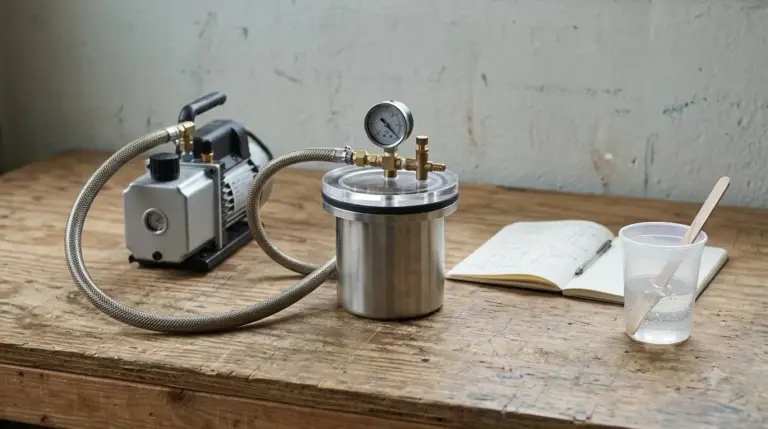 What Is Vacuum Degassing for Epoxy Resin and How It Removes Trapped BubblesUpdated Nov 26, 2026
 Epoxy Full Cure Time: How Long Before Your Project Is Ready to UseUpdated Nov 26, 2026
 Envirotex Lite Pour On Instructions for a Glossy, Bubble-Free FinishUpdated Nov 26, 2026
 Deep Pour vs Table Top Epoxy: Which Fits Your Project Depth and Cure TimeUpdated Nov 26, 2026
 High Temperature Epoxy for Metal: How to Pick One That Holds Up to HeatUpdated Nov 26, 2026
 Amazing Clear Cast Resin Instructions: Mix, Pour and Cure Without BubblesUpdated Nov 26, 2026