

We may earn a commission when you buy through links on this page, at no extra cost to you. Learn more.
How to get rid of epoxy smell comes down to better airflow, a correct mix, and letting the piece cure fully, which often takes 48 to 72 hours according to one resin guide. Epoxy is typically odorless or gives off a subtle scent, while the stronger smell comes from the reaction of resin and hardener during curing. Most odor fades once the material has dried, so the goal is to speed that process and keep fumes out of your breathing zone. Some hardeners, such as thiols, have a strong odor by nature, so the type you buy matters too.
This guide walks through how to tell normal off-gassing from a problem in your process, which fixes work during application and after curing, and when the smell is a sign to stop and reassess. It is written for hobbyists and DIYers working indoors in a garage, basement or spare room.
Why Epoxy Smells and What Causes the Odor
The smell comes mainly from vapors released when resin and hardener react, and the hardener is often the main source. Epoxy resins are usually described as odorless or faintly scented before they are mixed.
Volatile organic compounds, or VOCs, are carbon-based compounds that evaporate at room temperature. According to one epoxy supplier, VOCs in epoxy often sit in solvents or additives and escape into the air during curing. Solvent-based products tend to smell stronger than water-based ones, and two-part systems can smell more than one-part products.
Thiol hardeners deserve special mention. A 2023 study in an open-access low-odor thiol hardener study notes that thiol-based hardeners produce a strong odor that reduces work comfort, and that they take time to cure fully. The same study says thiols have a characteristic odor that people can detect in many two-component household adhesives.

Does Epoxy Smell Normally or Is Something Wrong?
A moderate smell during mixing and the first days of curing is common. A sharp, lingering odor that stays strong long after the piece should be hard is a sign to check your process.
Use this rough sorting as a starting point:
- Normal: a mild scent while mixing, fading over several days as the piece cures.
- Worth checking: a strong smell that stays the same after the cure time on the label has passed.
- Stop and reassess: headaches, dizziness, coughing or throat irritation while working.
According to one resin retailer, most odors dissipate within a few hours to a few days as the resin fully cures. If yours persists well beyond that, a mix problem or tacky spots are the usual suspects. Check the product’s technical data sheet for the stated cure time.
| What you notice | Likely cause | What to do |
|---|---|---|
| Mild smell while mixing | Normal hardener vapor | Keep airflow on and wait it out |
| Strong smell, piece still tacky | Incomplete cure or off ratio | Confirm ratio and temperature, then wait longer |
| Smell stays after full cure time | Residue, spills or poor ventilation | Clean spills and improve airflow |
| Headache or throat irritation | Concentrated vapor | Leave the room and ventilate before returning |
Safety: if you feel unwell, stop working and move to fresh air. Review the product’s safety data sheet for symptoms and first-aid steps.
Ventilation and Airflow Fixes That Work
Airflow is the fastest lever you control. Moving air carries vapor away from your face and dilutes what stays in the room. Ventilation matters most in small or windowless spaces, where fumes concentrate.
A practical setup looks like this:
- Open windows and doors on two sides of the room to create a cross-draft.
- Use an extractor fan to pull vapor out, or set a portable fan to blow air across the work area, not directly onto wet resin.
- Add an air purifier with activated carbon filters for the room, which can help when natural ventilation is limited.
- Work outdoors or in a garage when the weather allows, since these spaces usually have more air exchange.
Resin guidance also recommends keeping mixing containers and used gloves outside your main living space. Fumes from waste can linger long after the project is done.
Temperature and Humidity Effects on Odor
Temperature changes how fast epoxy cures and how strongly it smells. A cure area near 70°F is cited by one epoxy guide as the ideal temperature for maximizing curing and reducing odor. Very cold rooms slow curing, which can extend the period when odor is noticeable.
Heat speeds the reaction and can also raise vapor output. Avoid placing mixed resin near a heater or in direct sun. Keep the room at a steady temperature so the piece cures evenly instead of in patches.
Check the technical data sheet for the temperature range the manufacturer lists. Humidity guidance varies by product, so follow the label rather than a general rule.
Mixing Ratio Mistakes That Cause Strong Smells
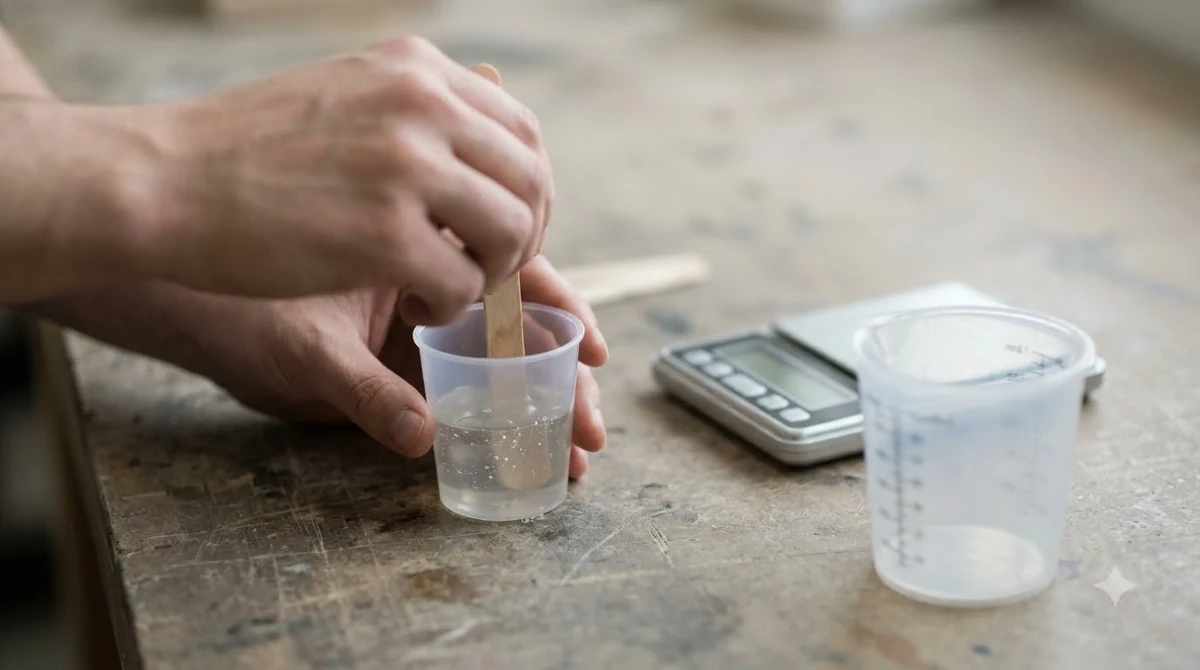
An incorrect ratio is one of the most common reasons epoxy smells stronger than it should. Epoxy systems can require mixing ratios from 1:1 to over 10:1, and the two parts must be measured accurately.
Common mistakes include:
- Eyeballing the measure instead of using graduated cups or a scale.
- Mixing a large batch at once, which generates more heat and can speed up the reaction unevenly.
- Leaving the hardener open to air and moisture before use, since hardeners are more reactive than resins.
- Skipping the mix-and-scrape step, which leaves unmixed resin in the corners of the container.
If you suspect a ratio error, the piece may stay tacky or soft. Some surfaces may never fully harden. For a fix, the safest route is usually to remove the uncured material and start again with a correctly measured batch.
Mixing in smaller batches also keeps the reaction under control. A large volume can heat up quickly, and the manufacturer’s technical data sheet should list the maximum batch size for your product. Readers working through this often move on to How to Get Rid of Epoxy.
Removing Odor From Cured Pieces and Workspaces
Once epoxy has fully cured, most of the smell should be gone. If you still notice odor, the remaining smell is often from the workspace rather than the finished piece. Common household options include the following:
- Baking soda: set open bowls around the room. It can help absorb odor, but it is a temporary measure.
- Activated charcoal: place it in the room to help absorb smells. Expect it to take hours or even days.
- Vinegar: some sources say it helps with lingering, strong odor, but it needs to be reapplied from time to time.
- Citrus peels and scented candles: these mask the smell, and the relief is usually short-lived.
A useful approach is to clean the work surface with mild soap and water to remove sticky spots, then run a HEPA air purifier or fan for several days. Resin guidance advises against masking the smell with air fresheners or incense, since those can react with fumes or irritate sensitive people. Wipe up spills from porous materials like wood or fabric before they cure into the surface.
Protective Gear: Respirators and Organic Vapor Cartridges
Protective gear reduces your exposure while you work. Gloves matter most for skin, and a respirator matters when vapor is strong or the room is hard to ventilate.
Rubber gloves give poor protection against epoxy. Wikipedia’s epoxy overview recommends gloves made of laminated multilayer plastic or thick reusable nitrile instead. A laboratory study of epoxy-based coatings found that disposable nitrile gloves were not permeated by the two formulations tested, though performance depends on the product.
For breathing protection, an activated carbon filter respirator is commonly recommended for reducing fumes during application. Choose a mask with a proper seal, since gaps let vapor in. Check the product’s safety data sheet to confirm which respirator and cartridge type it calls for.
Safety: epoxy can cause skin reactions and sensitization over repeated exposure. Wear gloves every time you handle resin or hardener, and read the safety data sheet before starting.
Troubleshooting Persistent Epoxy Smell
If the smell lingers after cure and ventilation, work through the likely causes in order. Start with the easiest checks before assuming the product is at fault.
- Confirm the cure. Press a hidden corner. If it is tacky, the cure is incomplete and the odor will stay.
- Check the ratio. Compare your measurements with the technical data sheet and remix if needed.
- Clean spills and waste. Remove sticky residue and discard contaminated gloves and cups outside the work area.
- Increase airflow. Add a fan, open more windows or move the project outdoors.
- Consider a low-odor product. One-part and low-VOC resins generally smell milder than standard two-part, higher-VOC options.
Resin guidance suggests that odorless formulations can speed up the time it takes for smells to fade. Still, even odorless products may have a faint scent during mixing. Read the labels closely, because odorless and low-VOC claims differ from product to product.
Frequently Asked Questions
How long does epoxy smell last after it cures?
Most odor fades within a few hours to a few days after the resin fully cures, according to one resin retailer. Cure time varies by product, and one epoxy guide gives 48 to 72 hours as a typical range. If the smell persists well past the listed cure time, check for an incomplete cure.
Does baking soda or vinegar actually remove epoxy odor?
Baking soda is described as helping neutralize odor, but only temporarily. Vinegar is said to help with strong, lingering smells and needs to be reapplied. Neither removes the source, so ventilation and full curing still do most of the work.
Is epoxy resin smell dangerous to breathe indoors?
Strong vapors can cause coughing, throat irritation, headaches or dizziness, especially in people sensitive to chemical odors. Good airflow and a respirator reduce that risk. If you feel unwell, leave the area and get fresh air, and consult the safety data sheet for guidance.
Which epoxy resins are low odor or odorless?
Products labeled low-VOC generally smell milder than higher-VOC options. Odorless and solvent-free formulas are also marketed for indoor use. Compare labels and data sheets, since claims vary and one-part products tend to smell less than two-part systems.
Cutting the smell comes down to good airflow, a correct mix, enough cure time and gloves plus a respirator when needed. If you want to understand the health side in more depth, read our guide on is epoxy resin toxic, and review the basics in Resin Safety before your next project.
More in Resin Safety
 Is There a Food Safe Epoxy? Yes, but Only When Fully CuredUpdated Nov 26, 2026
 Can You Put Food in Resin? Safer Choices and How to Prevent RotUpdated Nov 26, 2026
 Do You Need a Respirator for Resin? When Ventilation Is Enough and When It Isn’tUpdated Nov 26, 2026
 Food Coloring in Resin: Results, Fading and Safer AlternativesUpdated Nov 26, 2026
 Is Epoxy Food Safe Once Fully Cured? What Makers Need to KnowUpdated Nov 26, 2026
 Is EcoPoxy Food Safe? What Makers Should Verify Before UseUpdated Nov 26, 2026